
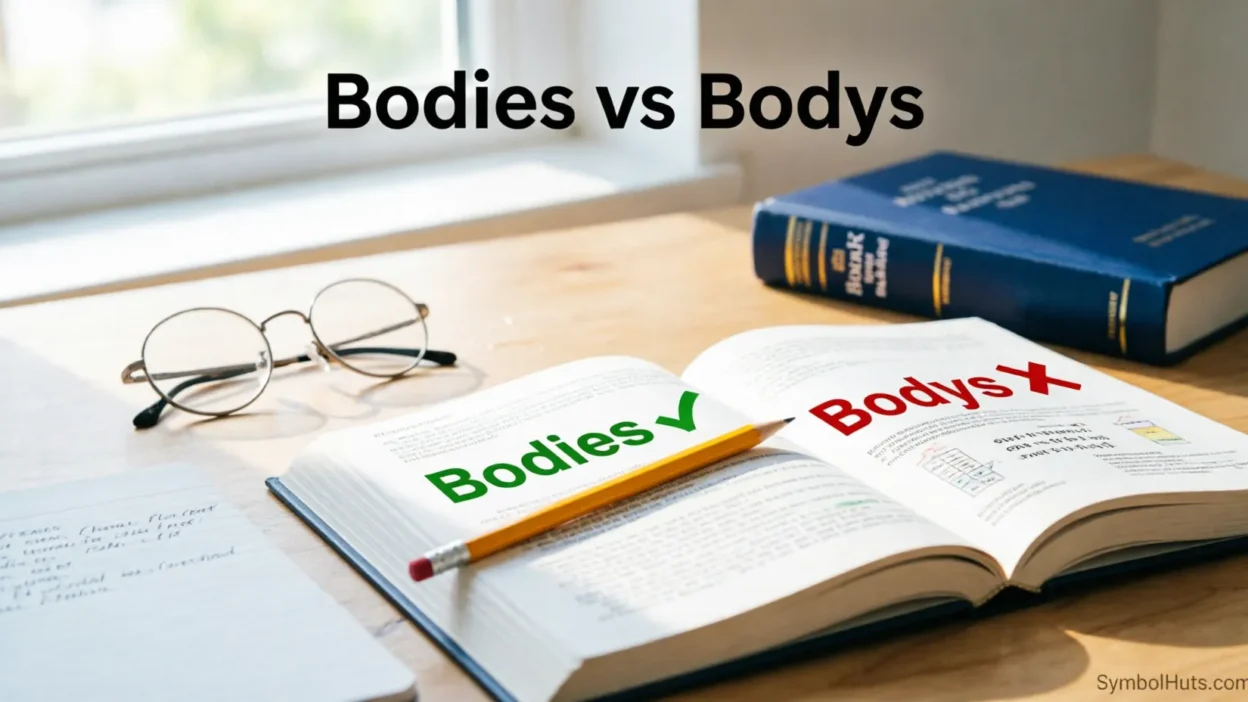
If you’ve ever wondered whether bodies vs bodys is the correct spelling, you’re not alone.
English plural rules can be confusing, especially when words ending in -y change differently depending on the letter before them.
Many students, writers, and English learners search for this exact question because both spellings look possible at first glance.
The good news is that the rule is simple once you understand it. In this guide, you’ll learn the correct plural form, why one spelling is right and the other is wrong, real-life examples, common mistakes to avoid, and helpful grammar tips that will make this rule easy to remember.
Quick Answer
The correct plural is bodies.
- ✅ Bodies = Correct plural of body
- ❌ Bodys = Incorrect spelling
The noun body ends with a consonant (d) followed by y. According to standard English grammar, the y changes to i before adding -es, resulting in bodies.
What Does “Body” Mean?
The word body has several meanings depending on the context. It commonly refers to:
- The physical structure of a person or animal.
- The main part of an object.
- A group or organization acting together.
- The central section of a written work.
No matter which meaning you use, the plural form remains bodies.
Examples
- The doctors examined the patients’ bodies.
- Several bodies were discovered by archaeologists.
- International bodies work together on global issues.
- The article has three main bodies of text.
Why Is “Bodies” Correct?
English has a standard spelling rule for nouns ending in consonant + y.
When a singular noun ends in:
Consonant + y
Change the y to i and add -es.
Body → Bodies
Other examples include:
- Baby → Babies
- City → Cities
- Story → Stories
- Lady → Ladies
- Party → Parties
This rule applies consistently in modern English grammar.
Why Is “Bodys” Incorrect?
The spelling bodys does not follow English pluralization rules. Since body ends with a consonant before the y, simply adding -s is grammatically incorrect.
Incorrect:
- ❌ Two bodys
- ❌ Human bodys
- ❌ Dead bodys
Correct:
- ✅ Two bodies
- ✅ Human bodies
- ✅ Dead bodies
Using bodys may make your writing appear unprofessional and could be marked as an error in school, exams, or professional documents.
Bodies vs Bodys Comparison Table
| Feature | Bodies | Bodys |
|---|---|---|
| Correct spelling | ✅ Yes | ❌ No |
| Standard English | ✅ Accepted | ❌ Not accepted |
| Dictionary entry | ✅ Yes | ❌ No |
| Used in academic writing | ✅ Yes | ❌ Never |
| Used in formal communication | ✅ Yes | ❌ Incorrect |
Examples in Everyday Sentences
Here are examples showing how bodies is used naturally.
Physical Bodies
- Healthy bodies need proper nutrition.
- The rescue team found several bodies after the accident.
- Children’s bodies grow rapidly.
Organizations
- Government bodies regulate public services.
- International bodies support humanitarian efforts.
- Scientific bodies publish new research regularly.
Objects
- The guitar bodies were made from maple wood.
- The car bodies were painted before assembly.
Common Mistakes People Make
Many learners accidentally write bodys because they assume every noun simply takes -s to become plural.
Common mistakes include:
- ❌ Bodys
- ❌ Body’s (when a plural is intended)
- ❌ Bodie
Correct versions:
- ✅ Bodies (plural)
- ✅ Body’s (possessive singular)
- ✅ Bodies’ (possessive plural)
Understanding the difference between plural and possessive forms helps avoid confusion.
Bodies, Body’s, and Bodies’ Explained
These three forms have different meanings.
| Word | Meaning | Example |
|---|---|---|
| Body | Singular noun | The body is healthy. |
| Bodies | Plural noun | The bodies were examined. |
| Body’s | Singular possessive | The body’s temperature increased. |
| Bodies’ | Plural possessive | The bodies’ conditions varied. |
Remember that apostrophes show possession, not plurals.
American vs British English
There is no difference between American English and British English for this word.
Both varieties use:
- ✅ Body
- ✅ Bodies
Neither American nor British dictionaries recognize bodys as a correct plural spelling.
This makes the rule easy to remember regardless of which version of English you use.
Similar Words Following the Same Rule
Learning similar words makes the grammar rule easier to remember.
| Singular | Plural |
|---|---|
| Baby | Babies |
| City | Cities |
| Story | Stories |
| Family | Families |
| Lady | Ladies |
| Party | Parties |
| Country | Countries |
| Body | Bodies |
All of these nouns end with a consonant followed by y, so they change y to i before adding -es.
Words That Do Not Follow This Rule
If a noun ends with a vowel + y, simply add -s.
Examples:
- Boy → Boys
- Toy → Toys
- Key → Keys
- Monkey → Monkeys
- Journey → Journeys
Notice that the y stays because it follows a vowel.
This is different from body, where the y follows the consonant d.
Tips to Remember the Rule
Keep these simple tips in mind.
- Look at the letter before y.
- If it’s a consonant, change y to i and add -es.
- If it’s a vowel, simply add -s.
- Never write bodys.
- Proofread your writing before submitting it.
A quick memory trick:
Consonant + y = ies
Vowel + y = s
When You’ll Use “Bodies”
You’ll frequently encounter bodies in many situations, including:
- Medical writing
- News reports
- Anatomy
- Fitness articles
- Biology textbooks
- Crime reports
- Government documents
- Academic research
- Everyday conversation
Because body is a common noun, knowing its correct plural improves both spoken and written English.
FAQs:
Is “bodys” ever correct?
No. Bodys is never considered correct in standard English grammar.
What is the plural of body?
The correct plural is bodies.
Why does body become bodies?
Because body ends with a consonant followed by y, English grammar changes y to i before adding -es.
Is bodies used in both American and British English?
Yes. Both American and British English use bodies with identical spelling and meaning.
What is the difference between bodies and body’s?
Bodies is the plural noun, while body’s shows possession by one body.
What is the plural possessive of bodies?
The plural possessive form is bodies’.
Example:
- The bodies’ positions were carefully documented.
Can grammar checkers detect “bodys”?
Yes. Most grammar and spell-check tools identify bodys as a spelling mistake and recommend bodies.
Summary
Understanding bodies vs bodys is straightforward once you know the pluralization rule.
The correct spelling is always bodies, because body ends with a consonant followed by y, requiring the y to change to i before adding -es. The spelling bodys is not accepted in standard English and should be avoided in academic, professional, and everyday writing.
If you’re unsure, remember this simple guideline: consonant + y = ies.
Applying this rule will help you correctly spell not only bodies but also many other common English nouns like babies, cities, and stories.
With regular practice, you’ll use the correct plural naturally and write with greater confidence.