
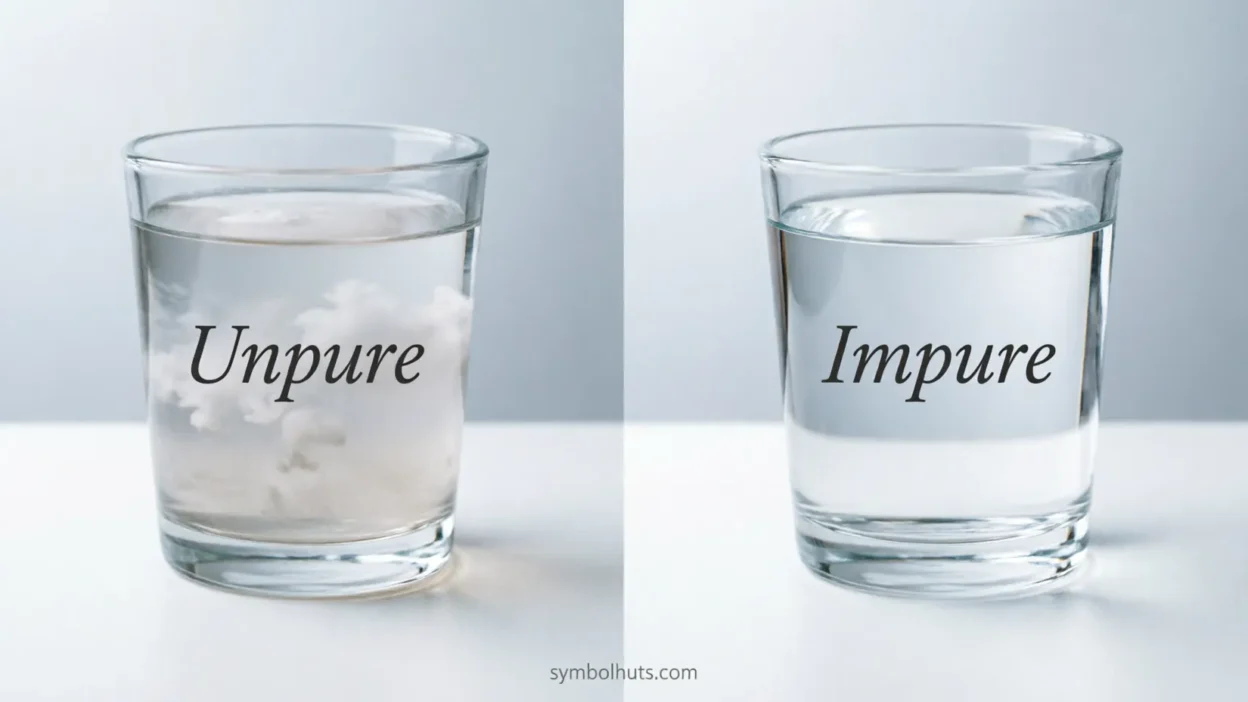
Have you ever wondered whether unpure vs impure is the correct spelling when describing something that is not pure? You are not alone. These two words look almost identical, and many English learners and even native speakers hesitate before choosing the right one.
The good news is that the difference is simple. In standard modern English, impure is the correct and commonly accepted word. Unpure is rare and generally considered nonstandard or awkward in everyday English. This guide explains the meaning, usage, examples, and common mistakes so you can confidently choose the right word every time.
Quick Answer: Unpure vs Impure
Impure is the correct and standard word in modern English.
- Impure = not pure; mixed with something else or contaminated.
- Unpure = a rare and generally nonstandard form that is usually best avoided.
Correct: The water was impure.
Less natural: The water was unpure.
When you mean “not pure,” use impure in both American and British English.
Unpure vs Impure: Which Word Is Correct?
The correct choice is impure.
The word impure is a standard English adjective formed with the prefix im-, meaning “not.” It describes something that lacks purity or has been mixed with another substance, quality, or influence.
Although unpure may occasionally appear in informal writing or older usage, it is not the normal word people use today. In most situations, native English speakers naturally choose impure.
So, if you are writing an essay, email, article, report, or professional document, impure is the safer and more natural option.
Impure Meaning Explained
Impure means not pure, mixed with unwanted substances, or lacking moral or spiritual purity.
The exact meaning depends on the context.
1. Physical meaning
When talking about a substance, impure means it contains other materials or contaminants.
Example:
The laboratory discovered that the sample was impure.
Here, the sample was not completely pure because it contained other substances.
2. Moral or personal meaning
Impure can also describe thoughts, intentions, or actions that are considered morally wrong or inappropriate.
Example:
He questioned whether his intentions were impure.
In this context, impure refers to a lack of moral purity.
3. Spiritual or religious meaning
In some religious or spiritual contexts, impure can describe something considered unclean or unsuitable according to religious beliefs.
Example:
The ancient text discusses pure and impure practices.
The meaning is strongly connected to the specific cultural or religious context.
What Does Unpure Mean?
Unpure is an uncommon form of “not pure.” However, it is not the standard choice in modern everyday English.
You may occasionally see unpure in older texts, unusual writing, or contexts where a writer deliberately uses the prefix un-. Still, it can sound unnatural to most modern English speakers.
For example:
The liquid was unpure.
This sentence is understandable, but “The liquid was impure” sounds much more natural and grammatically appropriate.
Is “Unpure” Always Wrong?
Not necessarily. English has many words that exist in rare, historical, or specialized usage. However, unpure is not the preferred standard word for general writing.
If your goal is clear, natural, and correct English, choose impure.
Unpure vs Impure Comparison Table
| Word | Meaning | Standard English? | Common Usage |
|---|---|---|---|
| Impure | Not pure or contaminated | Yes | Very common |
| Unpure | Not pure | Rare/nonstandard in modern usage | Very uncommon |
The main difference is usage and naturalness. While both may be understood, impure is the correct word for almost every modern English situation.
Examples of Impure in a Sentence
Here are some natural examples using impure:
- The scientist rejected the impure sample.
- The water became impure after the chemicals leaked.
- The metal was impure and required further processing.
- She worried that her motives were impure.
- The test showed that the substance was not completely pure.
- The jeweler removed the impure material from the gold.
- His intentions were considered impure by the community.
- The mixture was impure because it contained several unknown elements.
These examples show that impure can describe physical substances, intentions, motives, and broader ideas of purity.
Examples of Unpure in a Sentence
Although unpure is rarely used, you may encounter sentences like these:
- The old text described the substance as unpure.
- The writer called the water unpure.
- The character believed his thoughts were unpure.
However, in modern standard English, these sentences would generally sound better with impure:
- The substance was impure.
- The water was impure.
- His thoughts were impure.
The Simple Rule
If you are unsure, replace unpure with impure.
That small change will usually make your sentence sound more natural and polished.
Common Mistakes with Unpure vs Impure
Mistake 1: Assuming “un-” works with every adjective
Many English learners believe they can add un- to any word to create its opposite. Unfortunately, English does not work that way.
For example, unhappy is correct, but unpure is not the normal modern choice.
English prefixes often depend on word history and established usage.
Mistake 2: Using “unpure” in formal writing
Because unpure is understandable, writers sometimes use it in school assignments or professional documents.
However, impure is more precise, accepted, and natural.
Better: The sample was impure.
Avoid: The sample was unpure.
Mistake 3: Thinking “impure” only describes liquids
Some people associate impure only with water or chemicals. In reality, the word can describe metals, substances, motives, thoughts, intentions, and spiritual concepts.
Mistake 4: Confusing “impure” with “inappropriate”
These words are related in some contexts but do not have exactly the same meaning.
- Impure = not pure or contaminated.
- Inappropriate = unsuitable or not acceptable for a particular situation.
For example, an impure substance may contain contaminants, while an inappropriate comment may simply be unsuitable.
American vs British English: Is There a Difference?
There is no major American vs British English difference between unpure and impure.
Both American English and British English generally use impure as the standard word.
American English: The water is impure.
British English: The water is impure.
The spelling and meaning remain the same in both varieties of English.
Although unpure may appear occasionally in historical or unusual writing, it is not a common regional alternative in either American or British English.
Impure Synonyms and Related Words
Depending on your sentence, you may use these synonyms for impure:
- Contaminated
- Polluted
- Tainted
- Adulterated
- Mixed
- Unclean
- Corrupted
- Defiled
- Unrefined
Be careful when choosing a synonym because each word has a slightly different meaning.
For example, contaminated usually suggests harmful or unwanted substances, while unrefined often means something has not been processed or purified.
How to Remember the Correct Word
Here is an easy memory trick:
Think of the pair:
Pure → Impure
Just as we say possible → impossible, English uses im- in impure.
Whenever you are tempted to write unpure, pause and ask yourself:
“Would impure sound more natural here?”
In nearly every modern English sentence, the answer is yes.
FAQs:
1. Is “unpure” a real word?
Unpure can be found in rare or historical usage, but it is not the standard modern word most writers should use. In normal English, choose impure.
2. Is impure the opposite of pure?
Yes. Impure is the standard opposite of pure and means not pure or mixed with something unwanted.
3. Which is correct: unpure water or impure water?
Impure water is correct and natural. The phrase “unpure water” sounds unusual and should generally be avoided.
4. Do Americans say “impure”?
Yes. Impure is used in both American and British English with the same meaning and spelling.
5. Can impure describe a person’s intentions?
Yes. For example: “His intentions were impure.” In this context, impure refers to morally questionable or dishonest motives.
6. Why do people write “unpure”?
People often assume that adding un- creates the opposite of a word. However, English prefixes follow established usage, and impure is the natural standard form.
7. Is “impure” formal English?
Yes. Impure is a standard English adjective and is suitable for casual, academic, scientific, and professional writing.
8. What is the easiest way to remember impure?
Remember the pair pure → impure. If you mean “not pure,” impure is almost always the word you need.
Summary
When comparing unpure vs impure, impure is the correct and standard modern English word. It means not pure, contaminated, mixed, or lacking purity depending on the context. Although unpure may occasionally appear in rare or older writing, it is not the natural choice for everyday English.
There is no meaningful American vs British English difference here. Whether you are writing about impure water, an impure substance, or impure intentions, impure is the clear and accepted word. Choosing it will make your writing sound more natural and polished.
Actionable Takeaway
Use “impure” whenever you mean “not pure,” and avoid “unpure” in standard modern English writing.

Walter Terry is a skilled content creator and symbol researcher at SymbolHuts.com. He specializes in explaining symbols, their meanings, and visual communication in a clear, engaging way. Walter’s insightful content helps readers interpret visuals, understand symbolism, and connect ideas effectively across digital, educational, and creative contexts.