If you’ve ever typed hazard vs hazzard and wondered which spelling is correct, you’re not alone. Many English learners and native speakers accidentally add an extra “z”, creating the word hazzard. However, only one spelling is recognized in standard English.
In this guide, you’ll learn the correct spelling, meaning, pronunciation, examples, common mistakes, and simple tips to remember the difference. Whether you’re writing for school, work, or everyday communication, this article will help you use the right word confidently.
Quick Answer
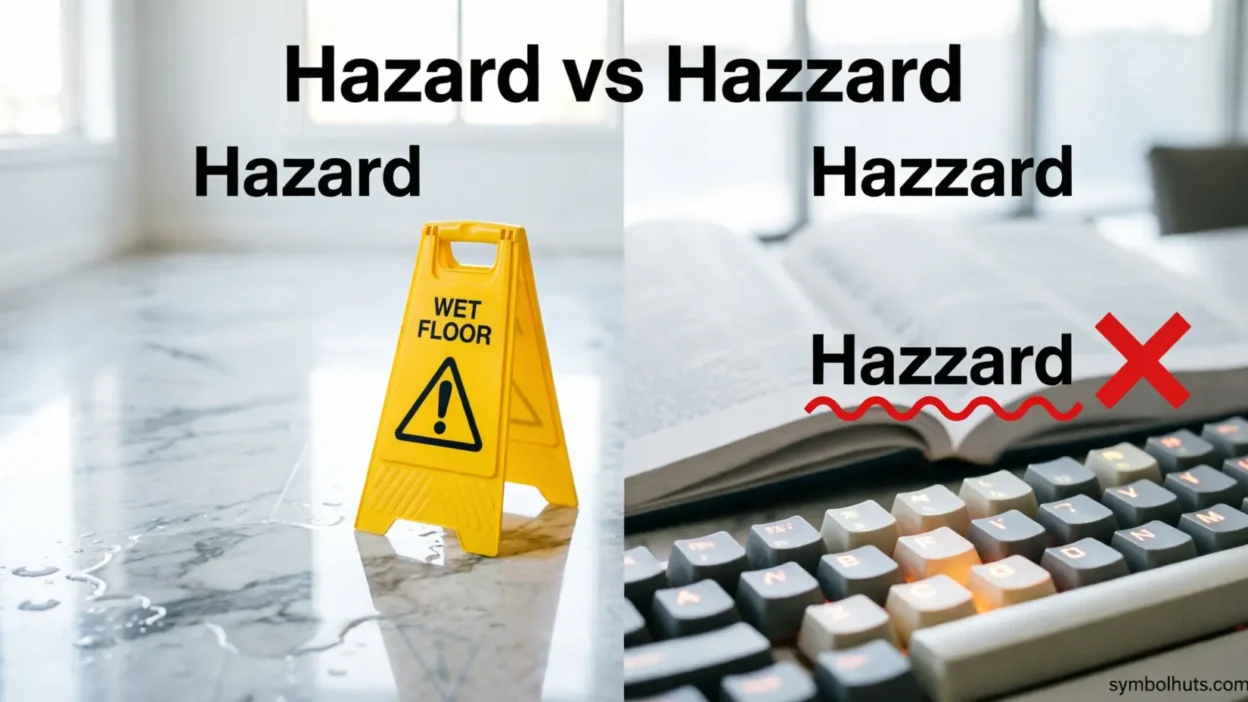
Hazard is the correct spelling and means a danger, risk, or source of potential harm.
Hazzard is generally an incorrect spelling and is not recognized as a standard English word. The only exception is when Hazzard appears as a surname, such as in The Dukes of Hazzard or as a person’s last name.
| Word | Correct? | Meaning |
|---|---|---|
| Hazard | ✅ Yes | A danger, risk, or potential source of harm |
| Hazzard | ❌ No (except as a surname) | Misspelling of hazard or a family name |
What Does Hazard Mean?
The word hazard refers to anything that can cause harm, injury, damage, or loss. It is commonly used in safety, health, construction, transportation, insurance, and environmental discussions.
Simple definition
A hazard is:
- A possible source of danger
- A risk that could lead to injury or damage
- Something that should be avoided or controlled
Examples
- Wet floors are a hazard in public buildings.
- Smoking is a serious health hazard.
- Driving during heavy fog creates a road hazard.
- Loose electrical wires are safety hazards.
What Does Hazzard Mean?
In most situations, hazzard has no meaning in English because it is simply a misspelling of hazard.
However, Hazzard can be a proper noun, usually a surname.
Examples include:
- The Dukes of Hazzard (television series)
- Someone whose last name is Hazzard
Unless you’re referring to a person’s name or a title, you should always write hazard.
Hazard vs Hazzard: Key Differences
| Feature | Hazard | Hazzard |
|---|---|---|
| Correct English spelling | ✅ Yes | ❌ No (except surname) |
| Dictionary word | Yes | No |
| Meaning | Danger or risk | Usually none |
| Used in writing | Yes | No |
| Used as surname | Rarely | Yes |
Why Do People Misspell Hazard as Hazzard?
There are several reasons people mistakenly write hazzard.
Double-letter confusion
English contains many words with double consonants, such as:
- Buzz
- Fizz
- Puzzle
- Jazz
Because of these examples, people sometimes assume hazard also has two “z” letters.
Pronunciation
The pronunciation of hazard can make the middle sound seem stronger, leading some writers to mistakenly type an extra “z.”
Typing habits
Fast typing, autocorrect errors, or unfamiliarity with the word can also result in writing hazzard instead of hazard.
Examples of Hazard in Sentences
Here are everyday examples showing the correct use of hazard.
- Ice on the sidewalk is a slipping hazard.
- Workers received training about workplace hazards.
- Chemicals should be stored away from potential fire hazards.
- Distracted driving is a major traffic hazard.
- Loud noise can become a hearing hazard over time.
- Floodwaters create serious public safety hazards.
- The broken ladder posed an immediate hazard.
- Environmental hazards affect both people and wildlife.
Incorrect Examples
These examples should be avoided.
❌ The wet floor is a hazzard.
✅ The wet floor is a hazard.
❌ Fire is a serious hazzard.
✅ Fire is a serious hazard.
Common Phrases Using Hazard
You’ll often see hazard in these expressions:
- Hazard warning
- Hazard lights
- Hazard pay
- Hazard assessment
- Hazard identification
- Hazard management
- Hazard symbol
- Fire hazard
- Health hazard
- Safety hazard
- Environmental hazard
- Occupational hazard
- Hazardous materials
- Hazard control
- Biological hazard
These phrases appear frequently in workplace safety, government regulations, healthcare, and emergency management.
Hazard as Different Parts of Speech
Noun
Most commonly, hazard is a noun meaning danger or risk.
Example:
- The uncovered hole was a hazard.
Verb
Less commonly, hazard can be used as a verb meaning to risk or suggest something without certainty.
Examples:
- I would hazard a guess.
- She hazarded an opinion during the discussion.
Hazard vs Risk
Although people often use these words together, they are not identical.
| Hazard | Risk |
|---|---|
| Something that can cause harm | The chance that harm will occur |
| Source of danger | Likelihood of danger causing damage |
| Exists on its own | Depends on exposure to the hazard |
Example
A chemical is a hazard.
The possibility that someone is exposed to it is the risk.
Understanding this distinction is especially important in workplace health and safety.
American vs British English
When comparing hazard vs hazzard, there is no spelling difference between American and British English.
Both varieties use:
- Hazard ✅
Neither uses hazzard as the standard spelling.
The pronunciation is also very similar, with only slight accent differences.
Common Mistakes to Avoid
Many writers make these errors:
- Adding an extra “z” (hazzard)
- Confusing hazard with hazardous
- Mixing hazard and risk
- Assuming spellcheck will always catch the mistake
- Copying incorrect spellings from social media
Always remember that dictionaries recognize only hazard unless referring to a surname.
Easy Trick to Remember the Correct Spelling
Think of this sentence:
A hazard has only one “z” because one mistake can create one danger.
Another memory trick:
- Hazard = one z
- Buzz = two z’s
This simple comparison helps many learners remember the correct spelling.
Related Words and LSI Keywords
Understanding related vocabulary strengthens your writing and improves comprehension.
Related words include:
- Danger
- Risk
- Threat
- Peril
- Safety
- Unsafe condition
- Harm
- Accident
- Workplace safety
- Hazardous
- Hazard warning
- Environmental risk
- Occupational hazard
- Emergency
- Prevention
- Protective measures
- Public safety
- Exposure
- Safety inspection
- Health risk
Using these naturally alongside hazard makes your writing more comprehensive and SEO-friendly.
When Is “Hazzard” Correct?
There are only a few situations where Hazzard is correct.
These include:
- A person’s last name
- A business name
- A book, movie, or television title
Example:
- The Dukes of Hazzard is spelled with two “z” letters because it is a proper name.
Outside these situations, use hazard.
FAQs:
Is hazard or hazzard correct?
Hazard is the correct English spelling. Hazzard is usually a misspelling unless it is part of a proper name.
Why do people write hazzard?
People often add an extra “z” because of pronunciation, typing habits, or confusion with other English words that contain double letters.
Is hazzard in the dictionary?
No. Standard dictionaries do not recognize hazzard as a common English word. It only appears as a surname or proper noun.
What does hazard mean?
A hazard is something that has the potential to cause harm, injury, damage, or danger.
Is there a British spelling of hazard?
No. Both British and American English spell it hazard.
Can hazard be a verb?
Yes. As a verb, hazard means to risk or suggest something cautiously, such as “to hazard a guess.”
What is the difference between hazard and risk?
A hazard is the source of potential harm, while risk is the likelihood that the hazard will actually cause harm.
Summary
Understanding hazard vs hazzard is simple once you know the rule. Hazard is the only correct spelling in standard English and refers to a danger, risk, or source of potential harm. Whether you’re discussing workplace safety, health, travel, or everyday situations, hazard is the word you should use. Hazzard is generally incorrect unless it is part of a person’s surname or a proper title.
The easiest way to avoid mistakes is to remember that hazard has only one “z.” Before submitting emails, assignments, or professional documents, take a moment to check the spelling. Consistently using the correct form will improve your writing, boost your credibility, and help you communicate more clearly.
Actionable Takeaway
If you’re unsure about hazard vs hazzard, ask yourself whether you’re referring to danger or a person’s name. If you mean danger, always choose hazard. Making this small habit part of your proofreading routine will help eliminate one of the most common spelling mistakes in English.