Have you ever typed gummy and wondered whether gummie is also correct? You’re not alone.
Many people search for gummy vs gummie because both spellings appear online, especially in product names, social media posts, and informal writing.
Knowing the correct form can help you write more confidently and avoid common spelling mistakes.
In this guide, you’ll learn the difference between gummy and gummie, discover which spelling dictionaries recognize, see real-world examples, understand American and British English usage, and avoid the most common errors.
By the end, you’ll know exactly which spelling to use in any situation.
Quick Answer
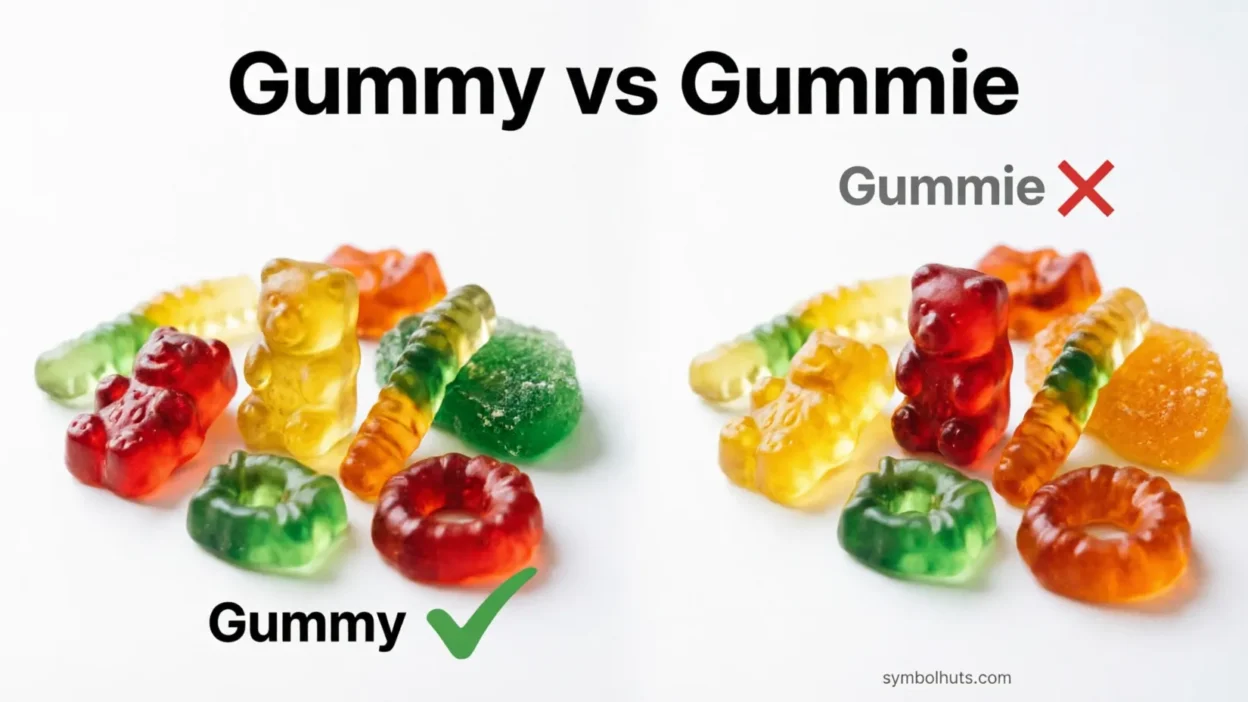
Gummy is the correct and standard English spelling. It is recognized in both American English and British English dictionaries.
Gummie is generally considered a misspelling or a nonstandard variation unless it is intentionally used as a brand name, username, or creative product title.
Correct: gummy bears, gummy candy, gummy smile, gummy vitamins
Usually Incorrect: gummie bears, gummie candy, gummie vitamins
What Does “Gummy” Mean?
The adjective gummy describes something that is:
- Soft and chewy
- Sticky or glue-like
- Covered with gum or a gum-like substance
- Related to gummy candy
It can also describe a person’s smile when too much of the gums are visible, commonly called a gummy smile.
Examples
- I bought a bag of gummy bears.
- These vitamins are available in gummy form.
- The cookies became gummy after sitting in the container overnight.
- She visited the dentist to discuss her gummy smile.
What Is “Gummie”?
The word gummie is not a standard English spelling.
In most situations, it appears because of:
- A typing mistake
- Phonetic spelling
- A creative brand name
- Social media usernames
- Informal online content
Although you may occasionally see gummie on websites or product labels, it is not accepted as the standard spelling in English dictionaries.
Gummy vs Gummie: The Main Difference
| Feature | Gummy | Gummie |
|---|---|---|
| Standard English spelling | ✅ Yes | ❌ No |
| Found in dictionaries | ✅ Yes | Rarely |
| American English | ✅ Preferred | ❌ Not standard |
| British English | ✅ Preferred | ❌ Not standard |
| Suitable for formal writing | ✅ Yes | ❌ No |
| Acceptable as a brand name | Sometimes | Yes, if intentionally branded |
The simple rule is easy to remember:
Use “gummy” in normal writing. Only use “gummie” if you’re referring to a specific brand or name that intentionally uses that spelling.
Why Do People Confuse Gummy and Gummie?
There are several reasons why people search for gummy vs gummie.
1. Pronunciation
Both words sound exactly the same.
Since English contains many words ending in -ie, some people naturally assume gummie is acceptable.
2. Brand Names
Some businesses intentionally change spellings to create unique trademarks. Seeing these creative spellings can make people believe they are standard English.
3. Autocorrect and Online Content
User-generated content, social media posts, and online marketplaces sometimes contain spelling mistakes that spread quickly.
4. Plural Confusion
People often confuse gummies with gummie.
Remember:
- One candy: gummy
- More than one: gummies
Not:
- One candy: gummie
Is “Gummy” Correct in American and British English?
Yes.
There is no spelling difference between American English and British English for this word.
| English Variety | Correct Spelling |
|---|---|
| American English | gummy |
| British English | gummy |
| Canadian English | gummy |
| Australian English | gummy |
Unlike words such as color/colour or center/centre, gummy has the same spelling across major English varieties.
Common Uses of “Gummy”
The word gummy appears in many everyday contexts.
Gummy Candy
Perhaps the most familiar use is chewy candy.
Examples include:
- gummy bears
- gummy worms
- gummy rings
- gummy peaches
Gummy Vitamins
Many supplements come in chewable gummy form.
Examples:
- gummy multivitamins
- gummy calcium supplements
- gummy probiotics
Gummy Smile
In dentistry, a gummy smile refers to excessive gum tissue showing when smiling.
Example:
- The orthodontist suggested treatment for her gummy smile.
Gummy Texture
Foods may be described as gummy if they become sticky or chewy.
Example:
- The rice became gummy after overcooking.
Examples in Sentences
Here are some correct examples using gummy.
- My children love gummy bears.
- She prefers gummy vitamins instead of tablets.
- The dessert had a slightly gummy texture.
- The dentist treated his gummy smile.
- These gummy candies are fruit flavored.
- I accidentally left the candy in the sun, and it became gummy.
Incorrect examples:
- ❌ I bought gummie bears.
- ❌ These are my favorite gummie vitamins.
- ❌ She likes gummie candy.
Correct versions:
- ✅ I bought gummy bears.
- ✅ These are my favorite gummy vitamins.
- ✅ She likes gummy candy.
Common Mistakes to Avoid
When writing about gummy candy or similar topics, avoid these errors.
Writing “Gummie” Instead of “Gummy”
This is the most common mistake.
Correct:
- gummy candy
Incorrect:
- gummie candy
Confusing Singular and Plural
Correct:
- one gummy
- two gummies
Incorrect:
- one gummie
Assuming Every “-ie” Ending Is Correct
English contains many words ending in -ie, but that doesn’t mean every adjective follows that pattern.
Always check a trusted dictionary if you’re unsure.
Tips to Remember the Correct Spelling
A simple memory trick can help.
Think of these words:
- funny
- sunny
- fuzzy
- gummy
Notice they all end with -y.
The pattern is consistent, making gummy easy to remember.
Related Words and LSI Keywords
If you’re writing about gummy products, these related terms naturally fit the topic:
- gummy candy
- chewy candy
- gummy bears
- gummy worms
- fruit gummies
- gummy vitamins
- gummy supplements
- chewy sweets
- soft candy
- gelatin candy
- pectin gummies
- gummy texture
- gummy smile
- spelling difference
- correct English spelling
- English grammar
- common spelling mistakes
Using these related phrases helps improve readability while covering the topic comprehensively.
When Might “Gummie” Be Acceptable?
Although gummie is not standard English, there are a few exceptions.
It may be appropriate if:
- It is part of a registered trademark.
- A company intentionally spells its product that way.
- It appears in someone’s username.
- You’re quoting text exactly as written.
Outside these situations, use gummy.
FAQs:
Is gummy or gummie correct?
Gummy is the correct standard English spelling. Gummie is generally considered incorrect unless used as a brand name or intentional creative spelling.
Why do some websites use gummie?
Some websites contain spelling mistakes, while others intentionally use gummie as part of branding or marketing.
Is gummie in the dictionary?
Major English dictionaries recognize gummy. Gummie is generally not listed as the standard spelling.
How do you spell gummy candy?
The correct spelling is gummy candy.
Is gummy used in both American and British English?
Yes. Both American and British English use gummy with the same spelling.
What is the plural of gummy?
The plural is gummies.
Example:
- I bought several gummies.
Can I use gummie in school or professional writing?
No. Standard writing should always use gummy unless you’re referring to a specific brand name.
Summary
The debate over gummy vs gummie is actually quite simple once you know the standard rule. Gummy is the correct spelling recognized in American English, British English, and other major varieties of English.
It is the preferred choice for dictionaries, academic writing, professional communication, and everyday use. In contrast, gummie is generally a misspelling unless it forms part of a deliberate brand name or creative title.
If you’re writing about gummy candy, gummy vitamins, gummy bears, gummy smiles, or anything with a soft, chewy, or sticky texture, stick with gummy. Doing so improves clarity, reflects standard English usage, and helps your writing appear more polished and trustworthy.
Actionable Takeaway
Whenever you’re unsure between gummy vs gummie, remember this simple rule: use “gummy” in all standard writing. Reserve “gummie” only for official brand names or exact quotations.
Following this guideline will keep your writing accurate, professional, and easy for readers to trust.

Christian Jeremy is a creative content writer and digital strategist at SymbolHuts.com. She specializes in exploring symbols, meanings, and visual communication, providing insightful and engaging content. With a passion for design and language, Christian helps readers understand symbolism, improve visual literacy, and connect with ideas in a clear and inspiring way.