
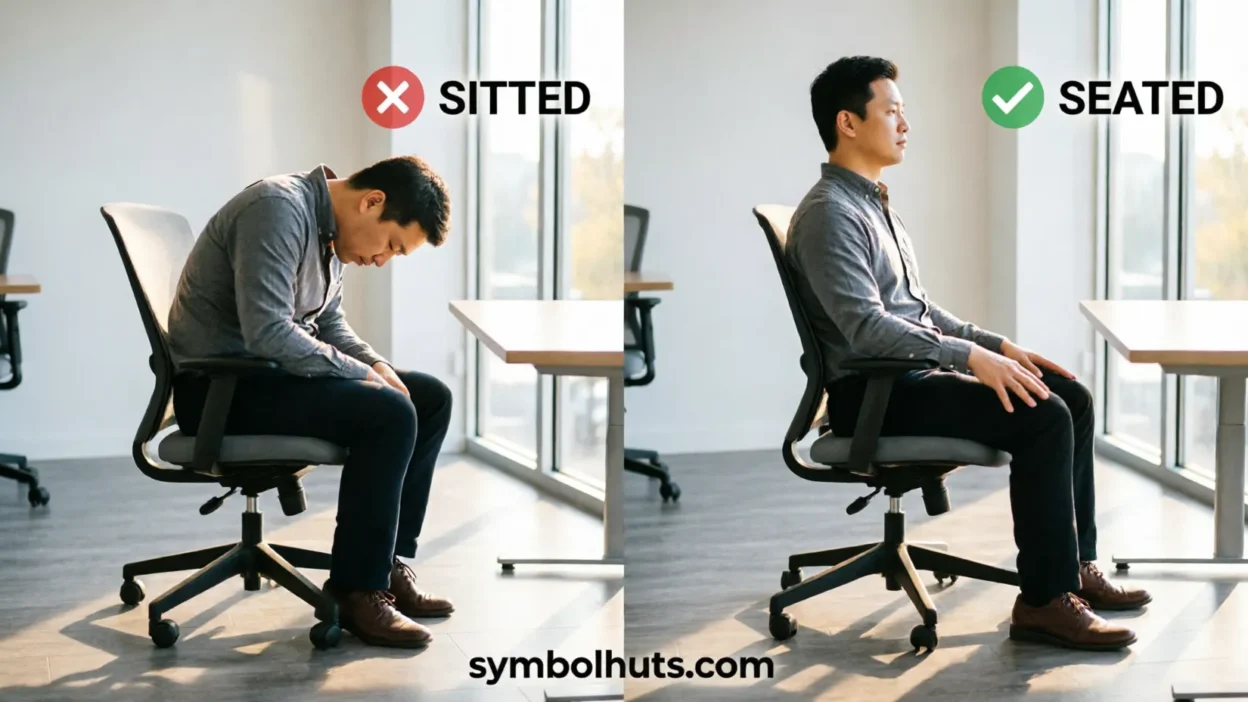
Have you ever written sitted vs seated and stopped to wonder which word is correct? You are not alone. This is a common English confusion because “sitted” looks like it should be the past tense of “sit,” but standard English does not use it that way.
The correct choice depends on what you want to say. In most situations, sat is the past tense of sit, while seated is a correct word used to describe someone who is sitting or has been placed in a seat. Let’s make the difference clear with simple explanations, examples, and easy grammar tips.
Quick Answer: Sitted vs Seated
“Sitted” is generally incorrect in standard English. “Seated” is correct, but “sat” is usually the correct past tense of “sit.”
| Word | Correct? | Meaning | Example |
|---|---|---|---|
| Sitted | ❌ No | Not standard English | I sitted on the chair. |
| Seated | ✅ Yes | Sitting or placed in a seat | She was seated near the window. |
| Sat | ✅ Yes | Past tense of sit | She sat near the window. |
Quick rule: Say “I sat” for the past tense of sit. Use “seated” when describing a person’s position or the act of placing someone in a seat.
Sitted vs Seated Meaning: What Is the Difference?
The confusion between sitted vs seated usually happens because English verbs do not always follow simple patterns.
The verb sit has these forms:
- Present: sit
- Past: sat
- Past participle: sat
- -ing form: sitting
So, we say:
- I sit here every morning.
- I sat here yesterday.
- I have sat here before.
- I am sitting here now.
“Sitted” is not the standard past tense or past participle of “sit.”
On the other hand, seated is a valid word. It can work as an adjective or as the past participle of seat, depending on the sentence.
What does “seated” mean?
Seated means sitting in a particular place or position. It can also mean placed in a seat.
For example:
The guests were seated at the dinner table.
This means the guests were sitting at the table, or someone arranged their seating there.
Why Is “Sitted” Incorrect?
Many English learners assume that adding -ed to a verb creates its past tense. That works for regular verbs such as:
- walk → walked
- clean → cleaned
- open → opened
However, sit is an irregular verb. Its past tense does not become sitted. Instead, it changes to sat.
This is similar to other irregular verbs:
- go → went
- take → took
- see → saw
- sit → sat
So, “I sitted down” is incorrect in standard English. The natural and grammatically correct sentence is:
I sat down.
This small mistake is common, especially among English learners and children who are still learning irregular verb forms.
When Should You Use “Seated”?
Use seated when you want to describe someone who is sitting or has been placed in a seat.
Examples of “seated” as a description
- The audience was seated quietly.
- He remained seated during the meeting.
- She was seated beside her mother.
- The passengers were seated in rows.
- Please remain seated until the plane stops.
In these examples, seated focuses on a person’s position or state.
“Seated” with formal language
The word seated often sounds more formal than sitting or sat.
For example:
The judge was seated in the courtroom.
This sounds formal and professional.
In everyday conversation, you might simply say:
The judge was sitting in the courtroom.
Both can be correct, but the tone is slightly different.
Sat vs Seated: The Difference You Really Need to Know
The biggest mistake people make is comparing sitted vs seated when the real comparison should often be sat vs seated.
Sat is the past tense of sit.
I sat on the sofa for two hours.
Seated describes someone who is in a sitting position or has been placed in a seat.
I was seated on the sofa.
These sentences are similar, but they have a slightly different focus.
| Feature | Sat | Seated |
|---|---|---|
| Base word | Sit | Seat |
| Word type | Past tense of sit | Past participle/adjective |
| Main focus | The action of sitting | A sitting position or placement |
| Tone | Natural and everyday | Often formal or descriptive |
| Example | She sat beside me. | She was seated beside me. |
Easy memory tip
Sit → sat. Seat → seated.
If you remember this simple pattern, you will rarely confuse sitted vs seated again.
Sitted vs Seated Examples in Real Sentences
Let’s look at some incorrect and correct examples to make the difference easier to understand.
Incorrect: “Sitted”
❌ I sitted on the chair.
✅ I sat on the chair.
❌ She sitted beside her brother.
✅ She sat beside her brother.
❌ We have sitted here before.
✅ We have sat here before.
Correct: “Seated”
✅ The guests were seated at their tables.
✅ He was seated near the entrance.
✅ Please remain seated during the presentation.
✅ The nurse asked the patient to stay seated.
A useful comparison
This tells us what I did.
This describes my position or suggests that I was placed there.
Common Mistakes with Sitted vs Seated
Understanding the grammar is helpful, but seeing common errors can make the rule stick.
Mistake 1: Using “sitted” as the past tense of “sit”
❌ She sitted on the floor.
✅ She sat on the floor.
Why? Sit is an irregular verb, so its past tense is sat.
Mistake 2: Using “seated” in every situation
Some people learn that seated is correct and then use it everywhere.
For example:
I seated on the sofa.
This is incorrect.
The correct sentence is:
I sat on the sofa.
Or:
I was seated on the sofa.
Seated usually needs the correct sentence structure, especially when it describes a person’s position.
Mistake 3: Confusing “seat” and “sit”
Sit means to take a sitting position.
Please sit down.
Seat means to place someone in a seat or provide a place to sit.
The usher seated the guests.
This difference is important because seated comes from seat, not directly from the past tense of sit.
American vs British English: Is “Sitted” Used Differently?
There is no standard American or British English rule that makes “sitted” correct. In both varieties of standard English, sat is the normal past tense of sit.
For example, both American and British speakers say:
I sat in the garden.
The word seated is also correct in both American and British English.
There may be informal regional speech or nonstandard usage where people say “sitted,” but it is not recommended in formal writing, academic English, professional communication, or SEO content.
American and British vocabulary note
The verb sit and its past tense sat are the same in American and British English. The main difference is often style and context, not spelling.
Seated may sound especially formal in official announcements, restaurants, ceremonies, and professional settings in both varieties of English.
Is “Sitted” Ever a Correct Word?
In standard modern English, “sitted” is generally considered incorrect when you mean the past tense of sit.
If you are writing an email, essay, article, application, or professional message, avoid sitted.
Use:
- sat for the past tense of sit
- sat as the past participle of sit
- seated to describe a sitting position or someone placed in a seat
The safest choice is simple: do not use “sitted” in standard English.
Sitted vs Seated: How to Remember the Correct Word
Here is an easy memory trick:
Sit → Sat → Sat
Think of the verb forms:
I sit today.
I sat yesterday.
I have sat here before.
Then remember:
If someone is seated, they are sitting or have been placed in a seat.
You can also remember the short phrase:
This one sentence shows the difference perfectly.
FAQs:
Is “sitted” a real word?
“Sitted” may appear in informal or nonstandard usage, but it is not considered correct standard English as the past tense of sit. Use sat instead.
Is “seated” the past tense of “sit”?
No. Seated comes from the verb seat. The past tense of sit is sat.
Should I say “I sat” or “I seated”?
Say “I sat” when you mean you took a sitting position. “I seated” usually means you placed someone or something in a seat and needs a suitable object.
Is “I was seated” grammatically correct?
Yes. “I was seated” is grammatically correct and means you were sitting or were placed in a seat.
What is the correct past tense of sit?
The correct past tense of sit is sat.
I sat on the bench.
Is “sitted” acceptable in British English?
No. “Sitted” is not standard British English as the past tense of sit. British speakers use sat.
Can I use “seated” instead of “sat”?
Sometimes, yes, but the meaning and tone may change slightly. Seated is often more formal or descriptive, while sat is the normal past tense of sit.
Which is correct: “I sitted down” or “I sat down”?
“I sat down” is correct. The phrase “I sitted down” is incorrect in standard English.
Summary
The main difference in sitted vs seated is simple: “sitted” is not the standard past tense of “sit,” while “seated” is a correct word related to “seat.” If you want to talk about something that happened in the past, use sat: I sat on the chair.
Use seated when you are describing someone who is sitting or has been placed in a seat. Both American and British English use sat and seated in the same basic way. Once you remember sit → sat and seat → seated, this common English grammar confusion becomes easy to avoid.
Actionable Takeaway
When writing sitted vs seated, remember: never use “sitted” for the past tense of “sit”—choose “sat,” and use “seated” for a sitting position or placement in a seat.

Noah Peter is a talented writer and researcher at SymbolHuts.com. She focuses on symbols, their meanings, and visual communication, delivering clear, engaging content. With a passion for design and creative expression, Noah empowers readers to understand symbolism, interpret visuals confidently, and connect ideas effectively in everyday life and digital spaces.