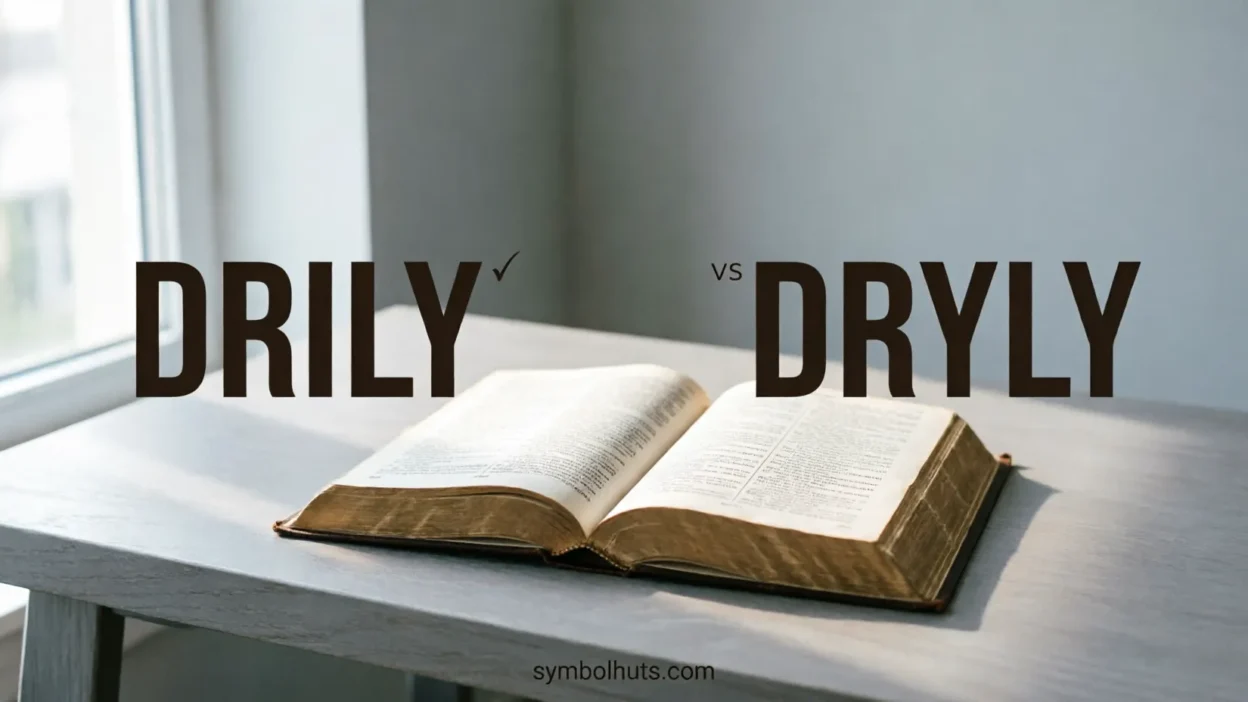
Have you ever paused while writing and wondered whether drily vs dryly is the correct spelling? You are not alone. These two adverbs look almost identical, and both are connected to the adjective dry.
The confusion usually comes from different spelling preferences and the way English changes words when adding -ly.
The good news is that drily and dryly are both correct words. In most cases, they have the same meaning and can be used interchangeably. However, one spelling is more common in certain varieties of English, and understanding the difference can help you write with greater confidence.
Quick Answer: Drily vs Dryly
Drily and dryly are both correct spellings.
They usually mean in a dry, unemotional, or sarcastic manner.
- Drily is often preferred in British English.
- Dryly is more common in American English.
- Both words can describe someone speaking with dry humor, irony, or little emotion.
Example:
“She drily remarked that the meeting was ‘absolutely thrilling.’”
Drily vs Dryly Meaning
The words drily and dryly are adverbs. They describe how someone says or does something.
Both words can mean:
The word dry has several meanings in English. In this context, it often relates to dry humor or dry wit. A person may say something funny without showing obvious emotion or excitement.
Example
- “Very funny,” he said dryly.
- “Very funny,” he said drily.
The meaning of both sentences is essentially the same. The speaker may be using sarcasm or understated humor rather than openly laughing.
Is Drily or Dryly Correct?
Both drily and dryly are correct.
This is not a case where one word is a spelling mistake. Both forms are recognized English adverbs.
However, dryly is generally more common in American English, while drily is often preferred in British English.
Simple rule to remember
If you write for an American audience, dryly may look more familiar.
If you follow British English spelling conventions, drily may be the preferred form.
That said, neither spelling is automatically wrong.
Drily Meaning Explained
Drily means in a dry, unemotional, or sarcastic manner.
It is formed from dry + -ly, with the y changed to i before adding the suffix.
Examples of drily
- “That went well,” she said drily.
- He drily observed that nobody had read the instructions.
- “What a surprise,” Maria replied drily.
In each example, the speaker is probably not expressing genuine excitement. The tone may be ironic, sarcastic, or deliberately emotionless.
Dryly Meaning Explained
Dryly has the same basic meaning as drily.
It means in a dry, restrained, or subtly humorous way.
Examples of dryly
- “I love waiting in traffic,” he said dryly.
- She dryly commented that the plan was “perfect.”
- “Of course this happened,” he said dryly.
The word dryly is especially common when describing dry humor or a sarcastic tone.
Drily vs Dryly: Comparison Table
| Feature | Drily | Dryly |
|---|---|---|
| Part of speech | Adverb | Adverb |
| Basic meaning | In a dry or unemotional manner | In a dry or unemotional manner |
| Correct spelling? | Yes | Yes |
| Common in British English | Often preferred | Also understood |
| Common in American English | Less common | Often preferred |
| Meaning | Same | Same |
| Related word | Dry | Dry |
As the table shows, drily and dryly have the same meaning in normal usage.
American vs British English: Drily and Dryly
The main difference between drily vs dryly is spelling preference rather than meaning.
American English
Dryly is generally the more familiar spelling for American readers.
Example:
“That sounds like a wonderful idea,” he said dryly.
British English
Drily is often preferred by British English writers.
Example:
“That sounds like a wonderful idea,” he said drily.
Does the spelling change the pronunciation?
Usually, no meaningful pronunciation difference exists between drily and dryly.
The difference is mainly written. This is why writers sometimes wonder whether one version is a typo.
Helpful tip: If you are writing for a specific audience, choose the spelling that matches your preferred English variety and use it consistently.
Examples of Drily vs Dryly in Sentences
Here are some clear examples to help you understand the usage.
Examples with “drily”
- “Brilliant timing,” she said drily.
- He drily mentioned that the computer had stopped working again.
- “I couldn’t possibly be more excited,” she replied drily.
- The manager drily noted that the report was only three weeks late.
- “Well, that was incredibly productive,” Tom said drily.
Examples with “dryly”
- “I just love surprise deadlines,” she said dryly.
- He dryly observed that the weather was not exactly ideal.
- “Another meeting? Wonderful,” she replied dryly.
- The writer dryly described the long journey as “slightly inconvenient.”
- “I suppose that could have gone better,” he said dryly.
Notice how the tone is often understated or ironic.
Drily vs Dryly: Common Mistakes
Although both spellings are correct, writers still make a few common mistakes.
Mistake 1: Thinking “drily” is always wrong
Some people assume drily is a misspelling of dryly.
That is incorrect. Drily is a valid English word and is especially common in British English usage.
Mistake 2: Thinking “dryly” is always wrong
The opposite mistake also happens. Some writers believe that the y must always change to i before adding -ly.
English spelling is not always perfectly predictable. Dryly is an established and widely used spelling, particularly in American English.
Mistake 3: Confusing “dry” with “drily” in meaning
In these examples, drily and dryly do not describe a lack of water.
For example:
“He answered dryly.”
This does not mean his answer was physically dry. It describes his tone or manner.
Mistake 4: Using “dryly” when you mean “quietly”
Dryly usually suggests understated humor, irony, or emotional restraint. It does not simply mean quietly or softly.
Why Do Both Drily and Dryly Exist?
The confusion comes from English spelling patterns.
When forming an adverb, words ending in -y often change the y to i before adding -ly. For example:
- happy → happily
- easy → easily
- angry → angrily
Following this pattern, dry → drily seems logical.
However, dryly also developed as a standard spelling. It keeps the original form of dry more visibly intact.
Over time, both spellings became accepted and established in English. Today, the choice is largely influenced by regional usage and style preference.
Drily vs Dryly in Formal and Informal Writing
Both words can be used in formal and informal writing.
Formal example
The report dryly noted that the projected deadline had already passed.
Informal example
“Great, another flat tire,” Jake said drily.
The words are particularly useful in:
- Creative writing
- Dialogue
- Journalism
- Reviews
- Essays discussing tone or humor
They help writers show a character’s attitude without directly saying, “He was being sarcastic.”
Which One Should You Use?
If you are still unsure about drily vs dryly, use this simple approach:
- Choose dryly for a primarily American English audience.
- Choose drily if you prefer British English conventions.
- In general writing, either spelling is correct.
- Most importantly, be consistent.
For SEO content, blogs, and everyday writing, dryly may be the safer choice for a broad American audience because it is widely recognized.
However, a British reader will understand drily immediately.
FAQs:
1. Is drily a correct word?
Yes. Drily is a correct English word. It means in a dry, unemotional, or subtly sarcastic manner.
2. Is dryly or drily more common?
Dryly is generally more common in American English, while drily is often preferred in British English. Both are correct.
3. Do drily and dryly mean the same thing?
Yes. In most situations, drily and dryly have the same meaning and can be used interchangeably.
4. Which spelling should I use in American English?
Dryly is usually the more familiar choice for American English readers.
5. Which spelling is preferred in British English?
Drily is often preferred in British English, although dryly is still understood and used.
6. Does drily mean without water?
No. In this context, drily refers to someone’s tone or manner, often involving dry humor or sarcasm.
7. Is “he said dryly” grammatically correct?
Yes. “He said dryly” is grammatically correct and describes the way he spoke.
8. Is dryly a synonym for sarcastically?
Sometimes, but not always. Dryly can suggest sarcasm, but it more broadly means speaking in an understated, unemotional, or subtly humorous way.
Summary: Drily vs Dryly
When comparing drily vs dryly, the most important thing to remember is that both spellings are correct. They are adverbs with the same basic meaning: in a dry, unemotional, restrained, or subtly humorous manner. The difference is mainly related to regional spelling preferences.
Dryly is generally more common in American English, while drily is often preferred in British English. Neither word is a spelling mistake, so you can confidently use the form that matches your audience and writing style.
Actionable Takeaway
Choose “dryly” for American English, “drily” for British English, and remember that both spellings are correct.

Walter Terry is a skilled content creator and symbol researcher at SymbolHuts.com. He specializes in explaining symbols, their meanings, and visual communication in a clear, engaging way. Walter’s insightful content helps readers interpret visuals, understand symbolism, and connect ideas effectively across digital, educational, and creative contexts.