
Have you ever paused while writing because you weren’t sure whether to use proceed or procede? You’re not alone. This is one of the most common spelling mistakes in English because the correct word doesn’t sound exactly the way it’s spelled.
In this guide, you’ll learn the difference between proceed vs procede, discover which spelling is correct, understand why people confuse them, and see plenty of real-life examples. By the end, you’ll know exactly which word to use with confidence.
Quick Answer
Proceed is the correct spelling in English.
Procede is an incorrect spelling and should never be used in standard American or British English.
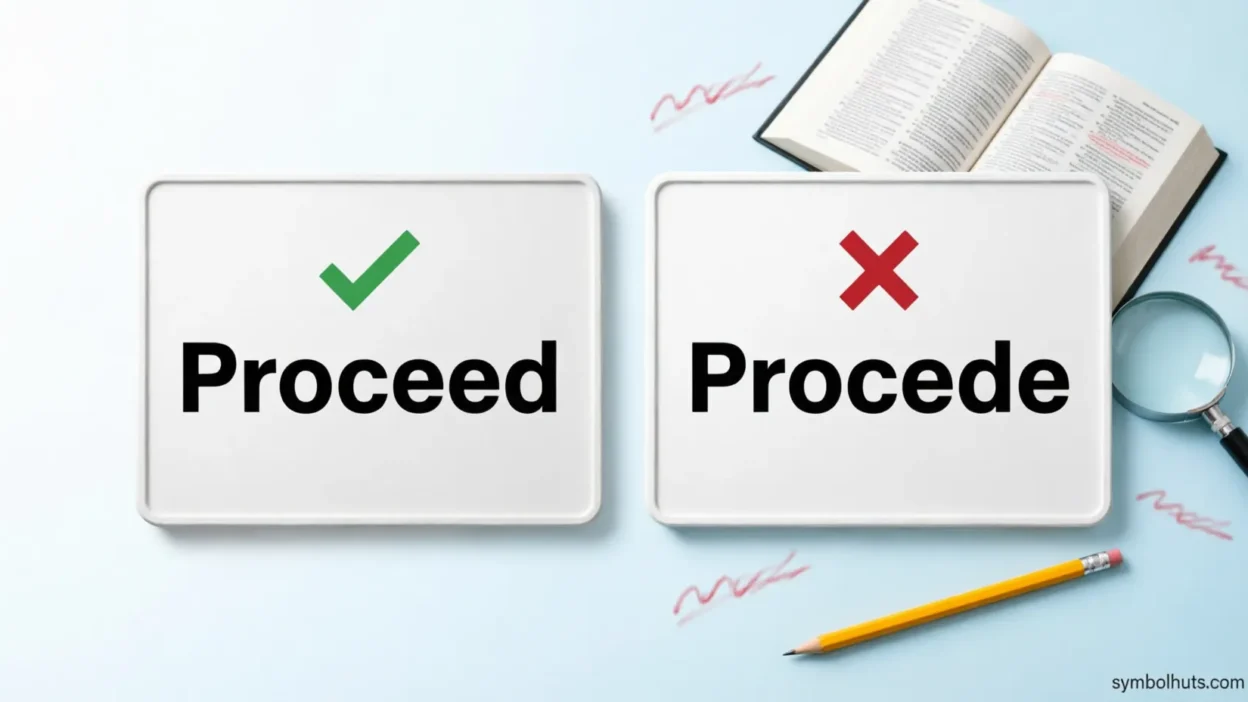
- ✅ Correct: Proceed
- ❌ Incorrect: Procede
If you want to mean to continue, move forward, or begin the next step, always write proceed.
Proceed Meaning
The word proceed is a verb that means:
- To continue after stopping.
- To move forward.
- To begin the next stage.
- To carry on with an action or process.
It comes from the Latin word procedere, meaning “to go forward.”
Examples
- Please proceed to the checkout counter.
- We will proceed with the meeting.
- After dinner, they proceeded to the theater.
- You may proceed when you’re ready.
Whether you’re writing an email, academic paper, business document, or text message, proceed is always the correct spelling.
What Is “Procede”?
Procede is simply a misspelling of proceed.
Although it may look reasonable because many English words end in -cede, this spelling is incorrect.
Examples of incorrect usage:
- ❌ Please procede to the next page.
- ❌ We will procede with the project tomorrow.
Correct versions:
- ✅ Please proceed to the next page.
- ✅ We will proceed with the project tomorrow.
Proceed vs Procede: Comparison Table
| Feature | Proceed | Procede |
|---|---|---|
| Correct spelling | ✅ Yes | ❌ No |
| Part of speech | Verb | Not a valid English word |
| Meaning | Continue or move forward | None |
| Used in dictionaries | Yes | No |
| Suitable for formal writing | Yes | No |
| American English | Correct | Incorrect |
| British English | Correct | Incorrect |
Why Do People Confuse Proceed and Procede?
Many English learners and native speakers accidentally write procede because of pronunciation and spelling patterns.
Here are the most common reasons:
- The double “ee” isn’t obvious when spoken.
- Many English words end in -cede, such as precede or recede.
- Fast typing often causes letters to be omitted.
- Autocorrect doesn’t always catch every typo.
Fortunately, remembering one simple rule solves the problem.
Proceed always contains two e’s together: “ee”.
Examples of Proceed in Everyday Sentences
Here are practical examples showing how proceed is used naturally.
At Work
- Let’s proceed with the presentation.
- The manager asked everyone to proceed carefully.
- We can proceed once the approval arrives.
At School
- Students may proceed to the next question.
- Please proceed quietly into the classroom.
While Traveling
- Passengers should proceed to Gate 12.
- After security, proceed directly to your departure lounge.
In Conversations
- You may proceed whenever you’re ready.
- Shall we proceed with the discussion?
Common Mistakes to Avoid
People often make these mistakes when writing.
Mistake 1: Writing “Procede”
❌ I will procede with the report.
✅ I will proceed with the report.
Mistake 2: Forgetting the Double “E”
Always remember that proceed has two e’s before the final “d.”
Mistake 3: Depending Only on Pronunciation
English spelling doesn’t always match pronunciation. Even though the word sounds simple, the spelling must remain proceed.
Easy Memory Trick
Here’s a simple trick:
Proceed has two “e”s because you need two steps to move forward.
Think of it like this:
Proc + ee + d
The double ee reminds you to keep moving ahead.
Another memory aid:
The repeated e can remind you that the action continues.
Synonyms of Proceed
Depending on the sentence, you can replace proceed with:
- Continue
- Carry on
- Move forward
- Advance
- Go ahead
- Progress
- Begin
- Follow through
- Resume
- Keep going
Example
Original:
- We will proceed with construction.
Alternative:
- We will continue with construction.
Opposites of Proceed
Common antonyms include:
- Stop
- Pause
- Halt
- End
- Finish
- Cease
- Delay
- Cancel
- Suspend
American vs British English
There is no spelling difference between American English and British English for this word.
Both varieties use:
- ✅ Proceed
Neither American nor British dictionaries recognize procede as a correct spelling.
So whether you’re writing in the United States, the United Kingdom, Canada, Australia, or elsewhere, proceed is always correct.
Grammar Tips for Using Proceed
The verb changes form just like other regular verbs.
| Tense | Example |
|---|---|
| Base form | proceed |
| Present | proceed / proceeds |
| Past | proceeded |
| Past participle | proceeded |
| Present participle | proceeding |
Examples
- She proceeds carefully.
- They proceeded after lunch.
- We are proceeding as planned.
- The meeting has proceeded smoothly.
Common Phrases Using Proceed
You’ll often see proceed in these expressions:
- Proceed with caution
- Proceed to checkout
- Proceed to payment
- Proceed to boarding
- Proceed to the next step
- Proceed accordingly
- Proceed as planned
- Proceed without delay
These phrases are common in business, education, technology, healthcare, and travel.
When Should You Use Proceed?
Use proceed whenever you mean:
- Continue an activity
- Move to another stage
- Go ahead after permission
- Advance through a process
Examples:
- Please proceed to registration.
- We can proceed after receiving approval.
- The judge allowed the lawyer to proceed.
- Once installed, proceed with the setup.
Why Correct Spelling Matters
Using the correct spelling improves:
- Professional communication
- Academic writing
- Business emails
- SEO content
- User trust
- Grammar accuracy
Misspellings like procede may make your writing appear less polished and can distract readers from your message.
FAQs:
Is procede a real English word?
No. Procede is not a recognized English word. It is simply a spelling mistake.
Which is correct: proceed or procede?
Proceed is the only correct spelling.
Why is proceed spelled with two e’s?
Its spelling comes from its historical Latin origin and has remained unchanged in modern English.
Is proceed used in both American and British English?
Yes. Both American and British English use the spelling proceed.
How can I remember the correct spelling?
Remember that proceed has a double “ee.” Think of the two e’s as two steps that help you move forward.
What does proceed mean?
It means to continue, move forward, or go ahead with an action or process.
Can I use proceed in formal writing?
Yes. Proceed is appropriate for academic, legal, professional, and everyday writing.
Summary
Understanding proceed vs procede is actually quite simple once you know the rule. Proceed is the only correct spelling and means to continue, move forward, or carry on with an action. Procede is a common misspelling that should be avoided in every type of writing, from emails and essays to business documents and online content.
The easiest way to remember the difference is to focus on the double “ee” in proceed. If you’re unsure, think of those two letters as representing the next steps in moving forward. Using the correct spelling will improve your writing, boost your credibility, and help you communicate more clearly.
Actionable Takeaway
If you write about continuing or moving forward, pause for a second and check the spelling. If it isn’t proceed with a double “ee,” correct it before publishing or sending your work. Building this small habit will make your writing more accurate, professional, and confident.

Christian Jeremy is a creative content writer and digital strategist at SymbolHuts.com. She specializes in exploring symbols, meanings, and visual communication, providing insightful and engaging content. With a passion for design and language, Christian helps readers understand symbolism, improve visual literacy, and connect with ideas in a clear and inspiring way.