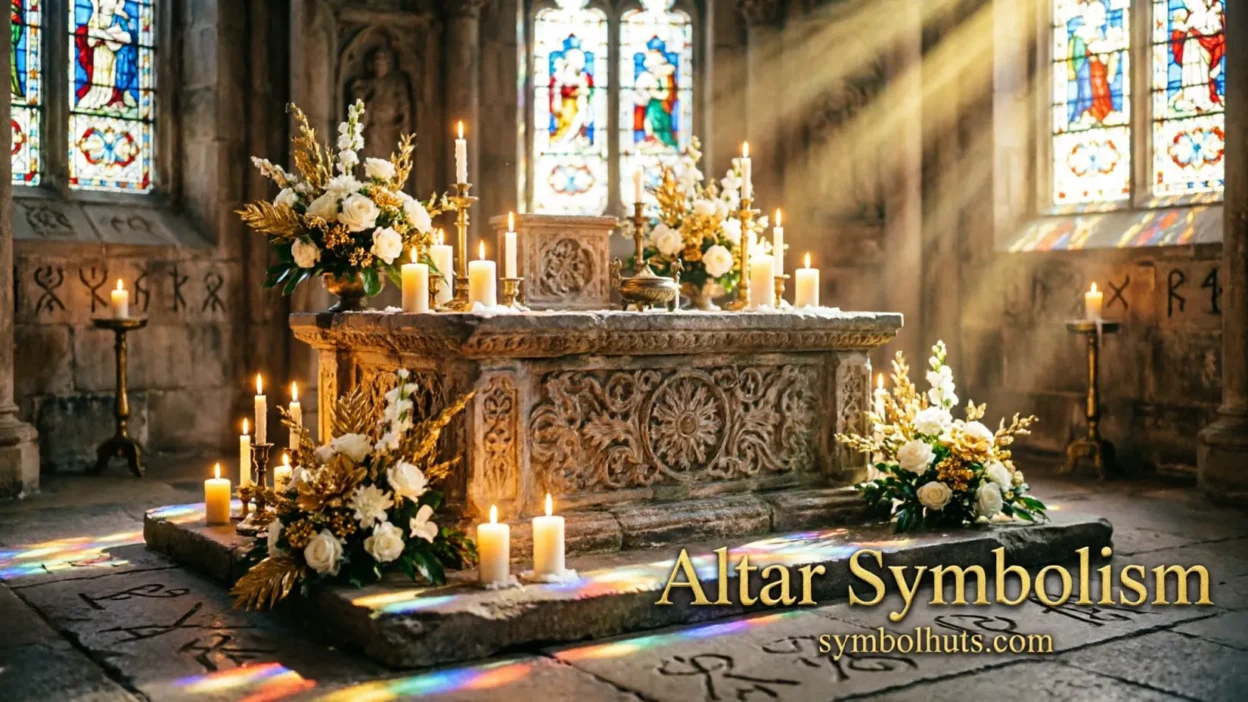
Altar symbolism has fascinated people for centuries because it represents devotion, sacrifice, transformation, and connection with the divine.
Across religions, cultures, and spiritual traditions, an altar serves as a sacred space where individuals seek guidance, offer gratitude, and honor higher powers.
Understanding altar symbolism can reveal deeper insights into faith, personal growth, and the human desire for spiritual connection.
Altar Symbolism Meaning (Clear Definition)
Altar symbolism refers to the deeper meaning associated with an altar, a sacred place used for worship, offerings, prayer, and spiritual ceremonies.
At its core, an altar symbolizes a meeting point between the physical and spiritual worlds. It represents dedication, reverence, sacrifice, and the intention to connect with something greater than oneself.
Quick Definition
Altar symbolism represents sacrifice, devotion, spiritual connection, transformation, and sacred communication.
What Does Altar Symbolism Represent?
An altar carries multiple symbolic meanings depending on cultural and spiritual contexts.
Some of the most common representations include:
| Symbolic Meaning | Interpretation |
|---|---|
| Sacrifice | Giving up something valuable for a higher purpose |
| Devotion | Commitment to faith, beliefs, or spiritual practices |
| Divine Connection | A bridge between humans and the sacred |
| Transformation | Personal growth and spiritual awakening |
| Gratitude | Offering thanks and appreciation |
| Worship | A dedicated place for prayer and reflection |
| Sacred Space | A protected area for spiritual activities |
These meanings make altar symbolism one of the most powerful spiritual symbols found throughout history.
Spiritual Meaning of Altar Symbolism
Spiritually, an altar symbolizes a place where inner transformation occurs. It represents the willingness to set aside distractions and focus on spiritual growth.
Many spiritual traditions view the altar as a sacred center where intentions are set and energies are directed. It becomes a symbol of mindfulness, faith, and self-discovery.
The spiritual meaning of an altar often includes:
- Seeking divine guidance
- Strengthening spiritual awareness
- Honoring sacred traditions
- Creating space for meditation
- Expressing gratitude and devotion
For many people, an altar serves as a reminder that spiritual growth requires commitment, reflection, and purpose.
Biblical / Religious Meaning of Altar Symbolism
In the Bible, altars hold significant religious importance. They were often built as places of worship, sacrifice, and covenant with God.
Notable biblical examples include:
- Noah building an altar after the flood
- Abraham constructing altars to honor God
- Moses establishing altars during important events
- The altar in the Temple used for sacred offerings
Biblically, altar symbolism often represents:
- Obedience to God
- Worship and praise
- Sacrifice and redemption
- Divine presence
- Spiritual commitment
In Christianity, the altar remains a sacred focal point in many churches, symbolizing communion, prayer, and devotion.
Other religions, including Hinduism, Buddhism, and various indigenous traditions, also use altars as sacred spaces for offerings, rituals, and spiritual practices.
Altar Symbolism in History and Culture
Throughout history, altars have appeared in nearly every civilization.
Ancient cultures used altars during religious ceremonies, seasonal festivals, and community gatherings. They often served as centers of worship and spiritual expression.
Historical Uses of Altars
- Ancient Egyptian temple rituals
- Greek and Roman sacrificial ceremonies
- Indigenous spiritual practices
- Medieval Christian worship
- Eastern religious traditions
Across cultures, the altar consistently symbolizes respect for the sacred and the desire to connect with divine forces.
Despite cultural differences, the core symbolism remains remarkably similar: reverence, sacrifice, and spiritual dedication.
Altar Symbolism in Literature and Art
In literature and art, altars are often used as powerful symbols of faith, commitment, and transformation.
Writers may use an altar to represent:
- Personal sacrifice
- Moral choices
- Spiritual awakening
- Redemption
- Dedication to a cause
Artists frequently depict altars to emphasize sacred moments or highlight the relationship between humanity and the divine.
An altar in artistic works can symbolize both external worship and an individual’s internal spiritual journey.
Dream Meaning of Altar Symbolism
Dreaming of an altar often reflects spiritual concerns, important decisions, or a desire for deeper meaning in life.
Common dream interpretations include:
| Dream Scenario | Possible Meaning |
|---|---|
| Praying at an altar | Seeking guidance or clarity |
| Building an altar | Creating a stronger spiritual foundation |
| Seeing a glowing altar | Spiritual awakening or inspiration |
| Kneeling before an altar | Humility and devotion |
| A damaged altar | Loss of faith or inner conflict |
Dream meanings vary based on personal experiences, emotions, and cultural beliefs, but altars generally symbolize reflection and spiritual awareness.
Modern Meaning of Altar Symbolism
Today, altar symbolism extends beyond traditional religious settings.
Many people create personal altars in their homes for meditation, mindfulness, remembrance, or spiritual practice. These spaces may contain meaningful objects such as candles, photographs, crystals, flowers, or sacred texts.
In modern life, altar symbolism often represents:
- Personal intention
- Inner peace
- Self-reflection
- Healing and growth
- Connection to personal values
Even outside formal religion, altars continue to serve as symbols of focus, purpose, and spiritual connection.
FAQs:
What is the main meaning of altar symbolism?
Altar symbolism primarily represents sacrifice, devotion, worship, and connection with the divine. It is often seen as a sacred meeting place between the physical and spiritual realms.
Why are altars important in religion?
Altars provide a dedicated space for prayer, offerings, worship, and spiritual ceremonies. They symbolize reverence and commitment to faith.
What does an altar symbolize spiritually?
Spiritually, an altar symbolizes transformation, intention, gratitude, and a deeper connection to higher wisdom or divine energy.
What does dreaming about an altar mean?
Dreaming about an altar often suggests spiritual reflection, important life decisions, personal growth, or a search for guidance.
Can an altar have a non-religious meaning?
Yes. Many people use personal altars as symbols of mindfulness, healing, remembrance, and self-discovery without following a specific religion.
Conclusion
Altar symbolism reflects humanity’s enduring desire to connect with something sacred and meaningful.
If viewed through spiritual, religious, historical, or personal perspectives, the altar remains a powerful symbol of devotion, transformation, gratitude, and inner growth.

Noah Peter is a talented writer and researcher at SymbolHuts.com. She focuses on symbols, their meanings, and visual communication, delivering clear, engaging content. With a passion for design and creative expression, Noah empowers readers to understand symbolism, interpret visuals confidently, and connect ideas effectively in everyday life and digital spaces.