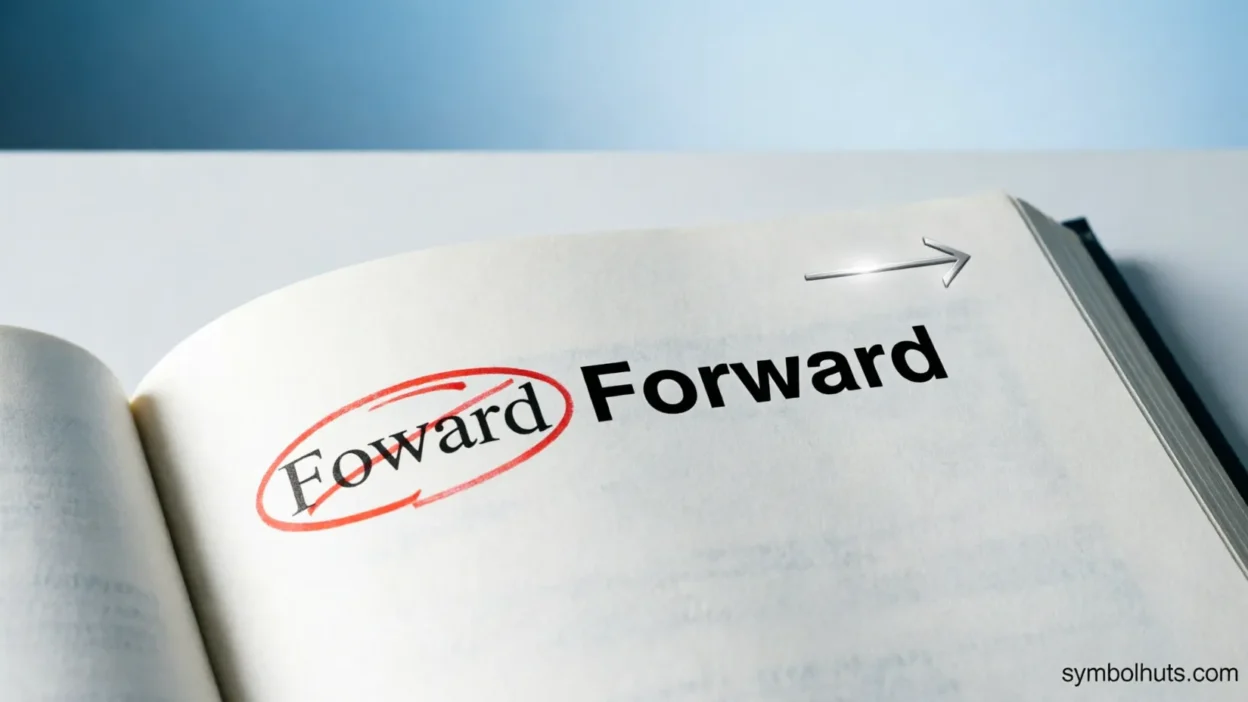
Have you ever typed foward vs forward and suddenly wondered which spelling is correct? You are not alone. This is a common spelling confusion because both words look almost identical, and the missing r in “foward” can easily go unnoticed during fast typing or writing.
In this guide, we will clearly explain the difference between foward and forward, identify the correct spelling, and show you how to use the word naturally in sentences.
If you are writing an email, school assignment, blog post, or professional message, this simple explanation will help you avoid the mistake with confidence.
Quick Answer: Foward vs Forward
Forward is the correct English spelling. Foward is a common misspelling and is not considered standard English.
- Forward = moving ahead, toward the front, or sending something onward.
- Foward = incorrect spelling of forward.
Correct: Please move forward with the plan.
Incorrect: Please move foward with the plan.
Foward vs Forward: Which Spelling Is Correct?
The correct spelling is forward.
The word foward is simply a spelling mistake. It often happens when writers accidentally leave out the second r. Because the pronunciation of forward can sound like “for-ward,” some people may type the word quickly and miss a letter.
If you are deciding between foward vs forward, always choose forward in standard English writing.
Correct spelling: Forward
Forward is used as an adjective, adverb, verb, and sometimes a noun. It can describe movement, progress, direction, or the act of sending something to another person.
Incorrect spelling: Foward
Foward does not have a separate meaning. It is a misspelling of forward.
Remember this simple rule: forward has two r’s.
What Does Forward Mean?
The word forward has several related meanings, but its central idea is movement or progress toward the front or ahead.
Forward as movement ahead
When someone moves forward, they move in front of their current position.
Example:
- The hikers continued forward despite the difficult weather.
Forward as progress
Forward can also describe progress or improvement.
Example:
- We need to move forward and focus on the future.
Forward as sending something
As a verb, forward means to send a message, email, or document to another person.
Example:
- Could you forward the email to the manager?
Forward as a direction
The word can also refer to the front or direction ahead.
Example:
- Please look forward while driving.
So, while the meaning can change slightly depending on the sentence, the correct spelling remains forward.
Foward vs Forward Comparison Table
| Feature | Foward | Forward |
|---|---|---|
| Spelling | Incorrect | Correct |
| Standard English | No | Yes |
| Meaning | None as a standard word | Ahead, onward, or toward the front |
| Common use | Typographical error | Everyday English |
| Example | Move foward | Move forward |
| Dictionary word | Generally not accepted | Yes |
This comparison makes the foward vs forward difference simple: one is a misspelling, while the other is the correct English word.
Examples of Forward in a Sentence
Seeing the correct spelling in context is one of the easiest ways to remember it.
- We must continue forward even when the path is difficult.
- She took one step forward.
- I will forward your message to the support team.
- The car moved forward slowly.
- He is looking forward to his vacation.
- The company is moving forward with its new project.
- Please forward the attached document to your colleague.
- The front seats are located forward of the main cabin.
Notice that forward can be used in different grammatical roles, but its spelling never changes to foward.
Common Mistakes with Foward vs Forward
Spelling mistakes are normal, especially when words have similar letter patterns. However, understanding the common errors can help you catch them quickly.
1. Leaving out the second “r”
The most common mistake is writing foward instead of forward.
Incorrect: Move foward.
Correct: Move forward.
A useful memory trick is to think of forward as containing “for” + “ward.”
2. Confusing spelling with pronunciation
Some people spell the word based on how they hear it. In casual speech, forward may sound less distinct, especially in certain accents.
However, pronunciation does not change the standard spelling.
3. Typing too quickly
The mistake foward is particularly common in emails, texts, and online writing. A quick proofreading check can easily catch it.
4. Assuming “foward” is a British spelling
Foward is not a standard British English variation. It is still considered a misspelling.
Forward in American vs British English
Is there an American and British English difference between forward and foward? No.
Both American English and British English use “forward” as the correct spelling.
There is, however, a small spelling variation involving forward and forwards.
American English
American English commonly uses forward as an adverb.
Example:
- She stepped forward.
British English
British English may use forwards in some contexts.
Example:
- She stepped forwards.
Both forward and forwards can be correct depending on regional usage and sentence structure. But foward is not the correct spelling in either variety of English.
Important note
Do not confuse forwards with foward. The word forwards is a legitimate spelling variant, while foward is simply a spelling error.
Why Do People Write Foward Instead of Forward?
The foward vs forward confusion usually comes from a simple letter omission.
The word forward contains a repeated r sound and letter pattern that can be easy to overlook. When people type quickly, they may write the word as they mentally hear it rather than carefully checking each letter.
Another reason is visual similarity. The words foward and forward look nearly identical at a glance. This means the error may remain unnoticed during proofreading.
If you frequently make this mistake, try slowing down when writing the word or use a simple memory trick: “For-ward has an extra r.”
How to Remember the Correct Spelling
Here are a few easy ways to remember forward:
- Forward = for + ward
- Remember that forward has two r’s
- Think: “I move forward, not foward.”
- Check for the r after fo and the r in for
A short memory sentence can help:
“I will move forward with the correct spelling.”
The more often you see and use the correct form, the more natural forward will become.
Is Foward a Word?
No, foward is not a standard English word. It is generally recognized as a misspelling of forward.
If you see foward in a message, document, or online post, the writer most likely intended to write forward.
For formal writing, academic work, business communication, and SEO content, always use forward.
FAQs:
1. Is “foward” or “forward” correct?
Forward is correct. Foward is a common spelling mistake and should be avoided in standard English writing.
2. Why do people spell forward as foward?
People often accidentally leave out the second r, especially when typing quickly or spelling the word based on its pronunciation.
3. Is foward a British English spelling?
No. Foward is not a British English spelling. The correct spelling is forward in both British and American English.
4. Can I use “forwards” instead of “forward”?
Yes, forwards is a valid variant in some contexts, especially in British English. However, foward is not a correct alternative.
5. What is the easiest way to remember forward?
Remember that forward has two r’s. You can also break it into “for” + “ward” to remember the spelling.
6. Is “forward” a verb?
Yes. As a verb, forward means to send something onward, such as an email or message.
Example: Please forward the email to me.
7. Does forward mean moving ahead?
Yes. Forward commonly means moving ahead, toward the front, or making progress.
8. How can I avoid writing foward?
Slow down when typing, proofread your work, and remember the spelling pattern for + ward. Spell-check tools can also help identify the error.
Final Summary
When comparing foward vs forward, the answer is simple: forward is the correct spelling, while foward is a misspelling. The word forward can describe movement ahead, progress, direction, or sending something onward. It is widely used in both American and British English.
Although forwards may appear as a valid regional variant, especially in British English, foward is never the correct spelling. If you remember that forward contains two r’s, you can easily avoid this common English spelling mistake in your writing.
Actionable Takeaway
Whenever you are unsure about foward vs forward, choose forward—and remember: “for” + “ward” = forward.

Walter Terry is a skilled content creator and symbol researcher at SymbolHuts.com. He specializes in explaining symbols, their meanings, and visual communication in a clear, engaging way. Walter’s insightful content helps readers interpret visuals, understand symbolism, and connect ideas effectively across digital, educational, and creative contexts.