Have you ever paused while writing because you weren’t sure whether to use discard or disgard? You’re not alone. Many English learners and even native speakers occasionally confuse these spellings because they sound similar. However, only one of them is accepted in standard English.
In this guide, you’ll learn the difference between discard vs disgard, discover why one spelling is correct, explore real-life examples, avoid common mistakes, and gain confidence in using the right word in everyday writing.
Quick Answer
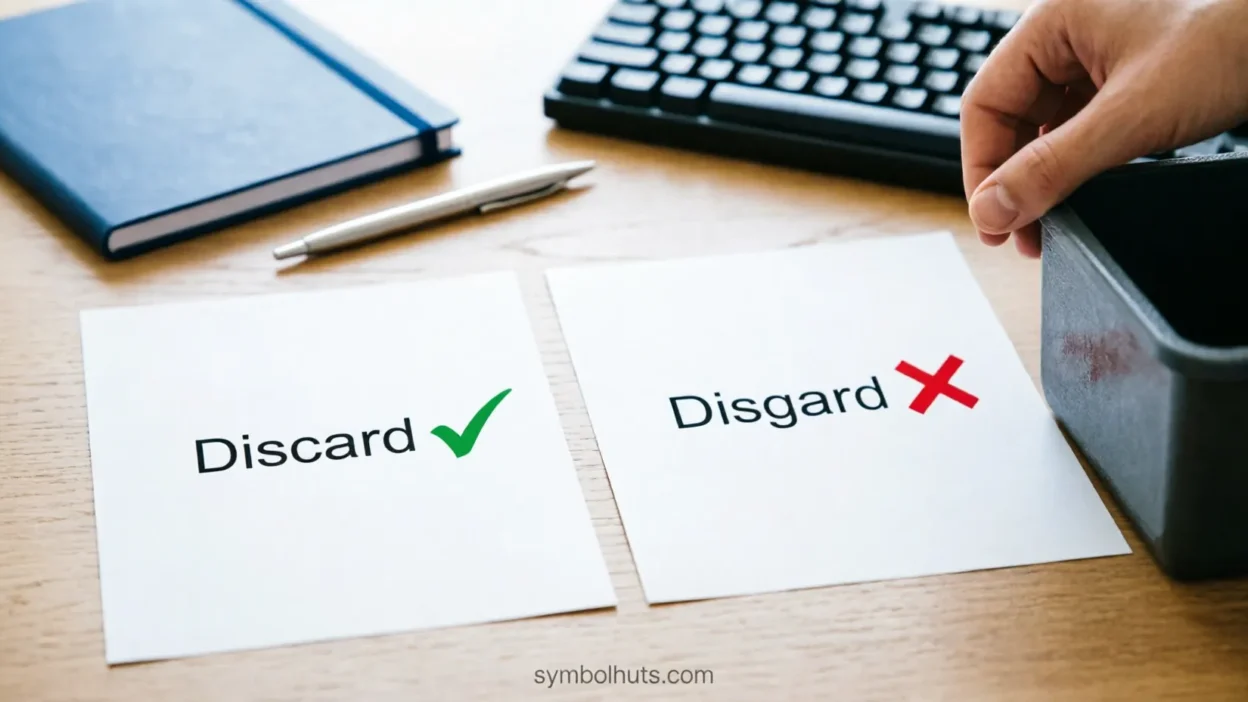
Discard is the correct spelling and means to throw away, get rid of, reject, or no longer use something.
Disgard is an incorrect spelling and is not recognized as a standard English word. If you mean to throw something away, always write discard.
| Word | Correct? | Meaning |
|---|---|---|
| Discard | ✅ Yes | To throw away, reject, or remove something |
| Disgard | ❌ No | Misspelling of discard |
What Does “Discard” Mean?
The verb discard means to get rid of something because it is no longer useful, wanted, or needed. It can describe throwing away physical objects, rejecting ideas, or removing unnecessary information.
Definition
Discard (verb): To throw away, abandon, reject, or stop using something.
Common synonyms
- Throw away
- Dispose of
- Get rid of
- Reject
- Eliminate
- Remove
- Cast aside
- Abandon
- Drop
- Toss out
These related terms help improve your vocabulary while keeping your writing natural and varied.
Is “Disgard” a Real Word?
No. Disgard is not a real English word.
It appears because many people mistakenly replace the “c” in discard with a “g.” English pronunciation can sometimes make these letters sound similar, leading to spelling confusion.
Whenever you see disgard, treat it as a spelling mistake and replace it with discard.
Correct:
- Please discard the old files.
- The company decided to discard the outdated policy.
Incorrect:
- Please disgard the old files.
- She disgard the broken toy.
Discard vs Disgard: Side-by-Side Comparison
| Feature | Discard | Disgard |
|---|---|---|
| Correct spelling | ✅ Yes | ❌ No |
| Dictionary word | Yes | No |
| Part of speech | Verb | None |
| Meaning | Throw away, reject, remove | No meaning |
| Suitable for formal writing | Yes | No |
| Suitable for academic writing | Yes | Never |
Why Do People Write “Disgard” Instead of “Discard”?
Several factors contribute to this common spelling mistake.
1. Similar pronunciation
The sounds of c and g can seem similar in fast speech, especially for English learners.
2. Typing errors
People often type quickly and accidentally press the wrong key.
3. Phonetic spelling
Some writers spell words based on how they hear them rather than how they are officially written.
4. Lack of familiarity
If someone has only heard the word spoken and never seen it in writing, they may guess the spelling incorrectly.
Examples of “Discard” in Sentences
Using discard correctly becomes easier after seeing it in context.
- Please discard the empty bottle after use.
- We decided to discard the damaged furniture.
- The teacher asked students to discard incorrect answers before revising.
- Doctors discard used medical gloves after each patient.
- You should discard expired medicine safely.
- The editor discarded unnecessary paragraphs.
- Scientists discarded unreliable data during the experiment.
- She discarded old clothes before moving.
- Don’t discard valuable opportunities too quickly.
- The software automatically discards temporary files.
Examples Showing the Incorrect Spelling
These examples illustrate mistakes you should avoid.
❌ Please disgard these papers.
✅ Please discard these papers.
❌ He disgard the broken phone.
✅ He discarded the broken phone.
❌ We need to disgard this idea.
✅ We need to discard this idea.
Common Mistakes to Avoid
Many writers make similar errors when using discard.
- Writing disgard instead of discard
- Forgetting the past tense discarded
- Using discard when ignore would be more appropriate
- Mixing discard with delete, even though they are not always identical
- Assuming spell-check will always catch the mistake
Proofreading your work helps eliminate these simple spelling errors.
When Should You Use “Discard”?
Use discard whenever you mean removing or rejecting something.
Examples include:
Throwing away objects
- Discard old newspapers.
- Discard broken equipment.
Rejecting ideas
- The committee discarded the proposal.
- Scientists discarded inaccurate theories.
Removing information
- Discard duplicate records.
- Discard unnecessary files.
Card games
In games like poker, players discard cards before drawing new ones.
Discard in Everyday English
You’ll frequently encounter discard in daily conversations and professional settings.
Examples include:
- Discard unwanted emails.
- Discard food packaging.
- Discard damaged products.
- Discard old passwords.
- Discard temporary notes.
- Discard expired coupons.
- Discard outdated software.
- Discard worn-out clothing.
Its broad usage makes it an essential English vocabulary word.
Grammar Tips
Discard functions mainly as a verb.
Present tense
- I discard
- You discard
- They discard
Past tense
- Discarded
Example:
- She discarded the damaged files yesterday.
Present participle
- Discarding
Example:
- He is discarding unnecessary documents.
Memory Trick to Remember the Correct Spelling
A simple trick can help you remember.
Think of discard as:
Imagine throwing away a card you no longer need.
Since card is spelled with a C, you’ll remember that discard also uses C, not G.
Discard in Formal and Informal Writing
The word discard works well in almost every writing style.
Formal writing
- Researchers discarded unreliable evidence.
- The organization discarded outdated procedures.
Informal writing
- Just discard the wrapper.
- I discarded those old magazines.
Because it is standard English, discard fits academic papers, business communication, emails, blogs, and everyday conversations.
American vs British English
There is no spelling difference between American and British English for this word.
Both varieties use:
- Discard ✅
Neither American English nor British English recognizes disgard.
Words Commonly Confused with Discard
These words have similar meanings but different uses.
| Word | Meaning |
|---|---|
| Discard | Throw away or reject |
| Delete | Remove digital information |
| Dispose | Get rid of properly |
| Reject | Refuse to accept |
| Eliminate | Remove completely |
| Ignore | Pay no attention |
| Abandon | Leave behind permanently |
| Remove | Take away |
Choosing the right word depends on the context.
Tips to Avoid This Spelling Mistake
Improve your spelling by following these habits.
- Read regularly to reinforce correct spelling.
- Use trusted dictionaries when uncertain.
- Proofread before publishing.
- Enable spell-check tools.
- Practice writing commonly confused words.
- Remember card inside discard.
These simple habits can greatly improve your written English.
FAQs:
Is discard or disgard correct?
Discard is correct. Disgard is an incorrect spelling and should never be used in standard English.
Is disgard found in dictionaries?
No. Reputable English dictionaries do not recognize disgard as a valid word.
What does discard mean?
It means to throw away, reject, remove, or stop using something.
Can I use discard in formal writing?
Yes. Discard is perfectly appropriate in academic, professional, and business writing.
Is discard used in computer terminology?
Yes. It often refers to removing temporary files, unsaved changes, unwanted data, or deleted items.
Why do people spell discard as disgard?
Most often because of pronunciation, typing mistakes, or unfamiliarity with the correct spelling.
Does British English spell it differently?
No. Both British English and American English use discard.
Summary
Understanding discard vs disgard is simple once you know the rule. Discard is the only correct spelling and means to throw away, reject, eliminate, or stop using something. Disgard is merely a misspelling that should be avoided in every type of writing, from casual messages to professional documents.
If you’re unsure, remember the easy memory trick: DIS + CARD. Since card is spelled with a C, discard is too. Building this habit will strengthen your spelling, improve your writing accuracy, and help you communicate with greater confidence.
Actionable Takeaway
The next time you write about getting rid of something, always choose discard. Add the DIS + CARD memory trick to your vocabulary toolkit, proofread your writing carefully, and you’ll never confuse discard vs disgard again.

Noah Peter is a talented writer and researcher at SymbolHuts.com. She focuses on symbols, their meanings, and visual communication, delivering clear, engaging content. With a passion for design and creative expression, Noah empowers readers to understand symbolism, interpret visuals confidently, and connect ideas effectively in everyday life and digital spaces.