
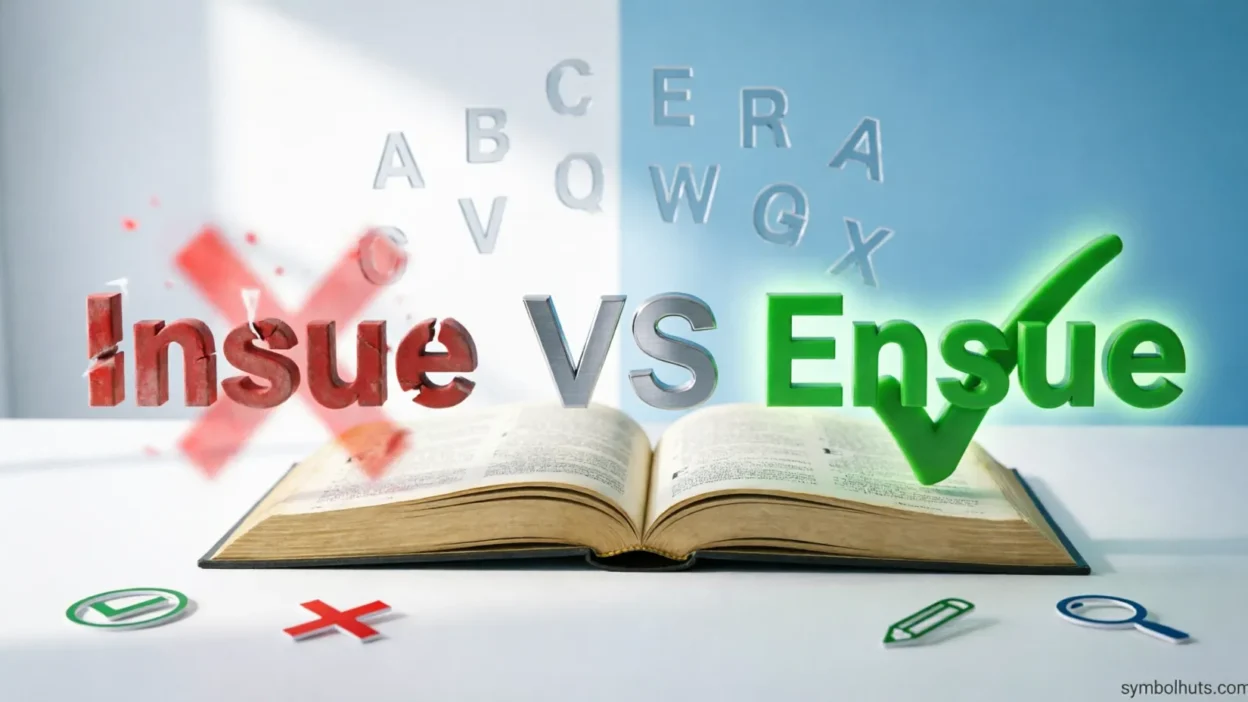
If you’ve searched for insue vs ensue, you’re probably wondering whether both words are correct or if one is simply a spelling mistake. This confusion is common because the two words sound almost identical when spoken. However, only one of them is recognized in standard English.
In this guide, you’ll learn the correct spelling, meaning, pronunciation, usage examples, common mistakes, grammar tips, and simple tricks to remember the difference. By the end, you’ll confidently know when to use ensue and why insue should be avoided.
Quick Answer
- Ensue is the correct English word.
- Insue is an incorrect spelling and is not accepted in standard English dictionaries.
- Ensue means to happen afterward, follow as a result, or occur because of something else.
Correct: Silence ensued after the announcement.
Incorrect: Silence insued after the announcement.
What Does Ensue Mean?
The verb ensue means to happen afterward or as a consequence of something that came before. It is commonly used to describe events that naturally follow another event.
Simple Definition
Ensue (verb): To happen next or occur as a result.
Synonyms
- Follow
- Result
- Develop
- Occur
- Arise
- Come after
- Take place
- Happen afterward
These related words can improve your writing while helping search engines understand the topic naturally.
Is Insue a Real Word?
No. Insue is not a standard English word.
It appears because many people spell ensue based on how it sounds. Since English pronunciation doesn’t always match spelling, this error is fairly common.
Modern dictionaries, grammar guides, and style manuals recognize only ensue.
Insue vs Ensue Comparison
| Feature | Insue | Ensue |
|---|---|---|
| Correct English word | ❌ No | ✅ Yes |
| Found in dictionaries | ❌ No | ✅ Yes |
| Part of speech | None | Verb |
| Meaning | None | To happen afterward or as a result |
| Appropriate in formal writing | ❌ No | ✅ Yes |
| Recommended usage | Never | Always |
How to Use Ensue Correctly
Ensue usually describes events that naturally follow another action or situation.
Examples
- After the heavy rain, flooding ensued.
- A heated debate ensued during the meeting.
- Confusion ensued after the announcement.
- Laughter ensued when the comedian told the joke.
- Several problems ensued because of the delay.
- Negotiations failed, and legal action ensued.
Notice that ensue often appears after another event has already been mentioned.
Why Do People Write “Insue”?
There are several reasons people mistakenly write insue.
1. Similar Pronunciation
The beginning of ensue sounds like “in” to many speakers.
2. Phonetic Spelling
People often spell unfamiliar words the way they hear them.
3. Typing Errors
Fast typing and autocorrect issues sometimes produce insue.
4. Lack of Familiarity
Because ensue isn’t used in everyday conversation as often as words like “happen” or “occur,” many writers aren’t confident about its spelling.
Memory Trick to Remember the Correct Spelling
Here’s a simple trick:
Ensue begins with “EN,” just like “END.”
Think of this sentence:
One event ends, and another event ensues.
This mental connection makes the spelling much easier to remember.
Common Mistakes to Avoid
Many learners make these errors.
Incorrect
- Problems insued after the storm.
- Confusion insues immediately.
- Several arguments insue.
Correct
- Problems ensued after the storm.
- Confusion ensues immediately.
- Several arguments ensue.
Always double-check the spelling before submitting academic or professional writing.
Verb Forms of Ensue
| Form | Example |
|---|---|
| Base form | ensue |
| Third person singular | ensues |
| Past tense | ensued |
| Past participle | ensued |
| Present participle | ensuing |
Examples
- A discussion ensues every Monday.
- The argument ensued quickly.
- The ensuing weeks were difficult.
- Several changes have ensued since then.
When Should You Use Ensue?
Use ensue whenever you describe a consequence or something that happens afterward.
Examples include:
- News reports
- Academic writing
- Legal documents
- Business communication
- Formal essays
- Books and novels
Example Sentences
- Panic ensued after the alarm sounded.
- Celebration ensued once the team won.
- Several meetings ensued following the merger.
- New opportunities ensued after the partnership.
Ensue vs Similar Words
Although ensue has related meanings, it isn’t always interchangeable with these verbs.
| Word | Meaning | Difference |
|---|---|---|
| Ensue | Happen afterward | Focuses on sequence or consequence |
| Follow | Come after | More general |
| Result | Be caused by | Emphasizes cause |
| Occur | Happen | Neutral meaning |
| Develop | Grow gradually | Indicates progression |
| Arise | Come into existence | Often refers to problems or situations |
Choosing the right word depends on context.
American vs British English
One helpful fact is that there is no spelling difference between American and British English.
Both varieties use:
- ✅ Ensue
- ❌ Insue
Whether you’re writing in the United States, the United Kingdom, Canada, Australia, or other English-speaking countries, ensue remains the accepted spelling.
Real-Life Examples
Here are examples similar to what you’ll find in newspapers, business writing, and everyday communication.
- A lengthy investigation ensued after the incident.
- The audience applauded, and cheers ensued.
- If safety procedures are ignored, serious consequences may ensue.
- Negotiations broke down, and uncertainty ensued.
- Heavy snowfall caused travel delays, and traffic chaos ensued.
These examples show how naturally ensue fits into formal and informative writing.
Common Grammar Tips
Keep these grammar rules in mind.
- Ensue is a verb.
- It usually follows an event already mentioned.
- It often introduces a consequence.
- It works well in formal writing.
- Avoid replacing it with insue, which is incorrect.
Frequently Asked Questions
Is insue a correct English word?
No. Insue is a misspelling. The correct spelling is ensue.
What does ensue mean?
It means to happen afterward or occur as a consequence of something else.
Why do people confuse insue and ensue?
Because both sound similar when spoken, many people spell the word phonetically.
Can I use insue in formal writing?
No. Professional, academic, and business writing should always use ensue.
Is ensue used in American English?
Yes. American English and British English both use ensue.
What is the past tense of ensue?
The past tense is ensued.
Example:
The meeting ended, and confusion ensued.
Is ensue a formal word?
Yes. It appears frequently in formal writing, journalism, academic papers, legal documents, and professional communication.
What words are similar to ensue?
Related words include follow, occur, result, arise, develop, take place, and come afterward.
Summary
The debate over insue vs ensue is actually quite simple. Ensue is the only correct spelling recognized in modern English, while insue is simply a spelling mistake caused by pronunciation and typing habits. Whenever you want to describe something that happens afterward or as a consequence of another event, ensue is the word to choose.
Using the correct spelling improves your writing, strengthens credibility, and helps avoid confusion in academic, professional, and everyday communication. Remember the simple memory trick—one event ends, and another event ensues—and you’ll rarely make this mistake again.
Actionable Takeaway
Before publishing or sending any piece of writing, quickly check whether you’ve written ensue correctly. If you ever see insue, replace it with ensue. Building this habit will make your English more accurate, polished, and professional.

Walter Terry is a skilled content creator and symbol researcher at SymbolHuts.com. He specializes in explaining symbols, their meanings, and visual communication in a clear, engaging way. Walter’s insightful content helps readers interpret visuals, understand symbolism, and connect ideas effectively across digital, educational, and creative contexts.