If you’ve searched for villain vs villian, you’re probably wondering which spelling is correct. It’s a common confusion because the words look very similar, but only one is accepted in standard English. If you’re writing an essay, a novel, a social media post, or an email, using the correct spelling helps you communicate clearly and professionally.
In this guide, you’ll learn the difference between villain and villian, why people mix them up, easy ways to remember the correct spelling, real-world examples, common mistakes, and answers to frequently asked questions. By the end, you’ll feel confident using the right word every time.
Quick Answer
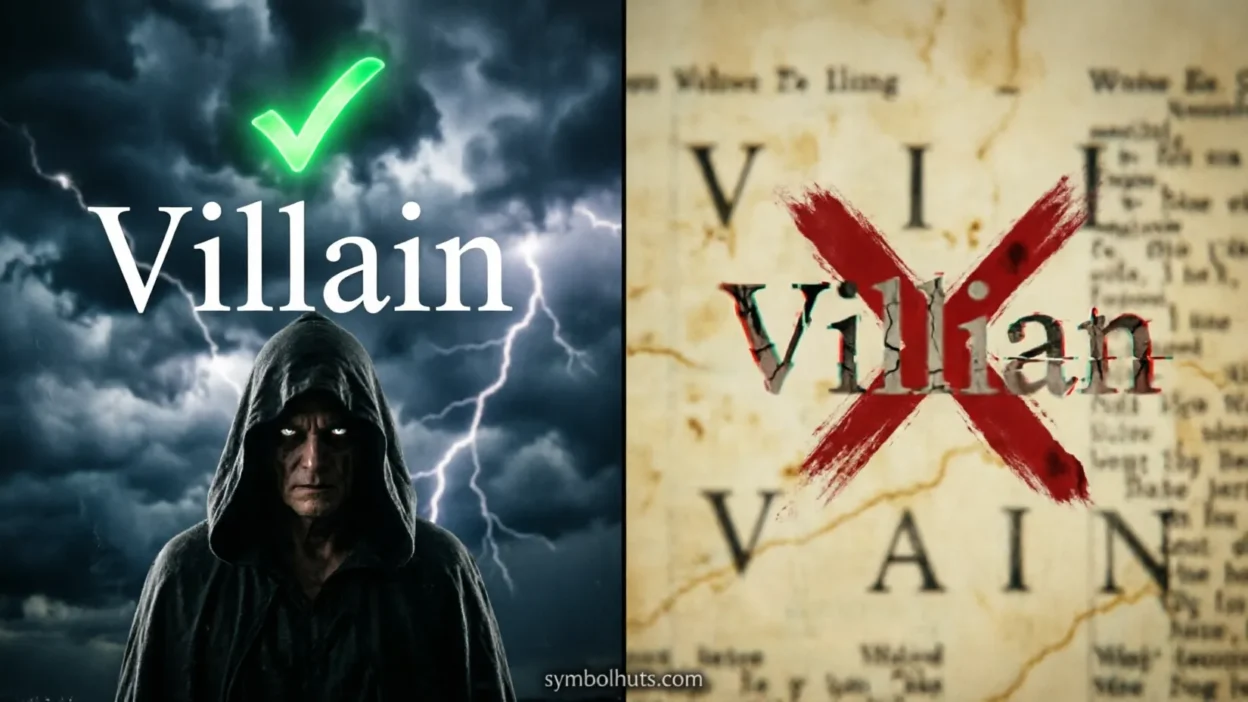
Villain is the correct spelling.
Villian is a misspelling and is not recognized as a standard English word.
- ✅ Correct: villain
- ❌ Incorrect: villian
Whenever you’re referring to an evil character, antagonist, criminal, or bad person in a story, always use villain.
Villain vs Villian: What’s the Difference?
The difference is simple:
- Villain is the correct English word.
- Villian is a spelling mistake caused by reversing the letters a and i.
Although many people accidentally type villian, dictionaries and style guides recognize only villain.
| Word | Correct? | Meaning |
|---|---|---|
| Villain | ✅ Yes | An evil or immoral character, especially the main antagonist |
| Villian | ❌ No | Incorrect spelling of villain |
What Does “Villain” Mean?
A villain is a person who causes harm, creates conflict, or opposes the hero in a story. The word is commonly used in literature, movies, television, comics, and everyday conversation.
A villain may be:
- An evil ruler
- A criminal
- A corrupt leader
- A dishonest person
- The antagonist in a novel or film
Examples
- The villain tried to destroy the kingdom.
- Every superhero needs a memorable villain.
- The detective finally caught the villain.
- The movie’s villain had an interesting backstory.
Is “Villian” a Real Word?
No.
Villian is not a real English word. It appears because people accidentally swap the letters a and i while typing or spelling.
Spell checkers usually flag villian as an error and suggest villain instead.
Whenever you see villian, replace it with villain.
Why Do People Misspell Villain as Villian?
There are several reasons why this mistake is so common.
Similar Letter Order
The letters a and i appear close together, making them easy to reverse.
Fast Typing
Typing quickly often leads to letter transposition errors.
Pronunciation
Both spellings sound nearly identical when spoken, making the mistake harder to notice.
Lack of Familiarity
People who don’t write the word often may rely on memory instead of checking the correct spelling.
Easy Trick to Remember the Correct Spelling
Think of this pattern:
Villain = vill + ain
Notice that “ai” comes before “n.”
Another memory tip:
A villain is the bad guy, and the AI in villain comes before the final n.
Reading books and seeing the correct spelling regularly also helps reinforce it.
Villain in Different Contexts
The word villain appears in many situations beyond fiction.
Literature
Classic novels often feature villains who challenge the hero.
Example:
- The villain manipulated everyone for personal gain.
Movies
Action films usually have a central villain.
Example:
- The superhero defeated the villain in the final battle.
Comics
Comic books are famous for iconic villains.
Example:
- Batman has many unforgettable villains.
Everyday Conversation
People sometimes use villain figuratively.
Example:
- He became the villain of the office after spreading rumors.
Examples of Correct and Incorrect Usage
Correct
- The villain escaped from prison.
- She wrote a fascinating villain with complex motives.
- Every fairy tale has a villain.
- The villain planned everything carefully.
- Audiences loved the villain almost as much as the hero.
Incorrect
- The villian escaped from prison.
- She created an unforgettable villian.
- The movie’s villian was frightening.
These should all be written as villain.
Common Mistakes People Make
Many English learners and even native speakers make similar spelling errors.
Mixing Up the Letters
❌ Villian
✅ Villain
Assuming Both Spellings Are Accepted
Only villain appears in dictionaries.
Ignoring Spell Check
Modern writing tools can usually catch this mistake.
Memorizing the Wrong Version
Repeatedly seeing the incorrect spelling online can make it seem correct, but it isn’t.
Villain vs Villian Comparison Table
| Feature | Villain | Villian |
|---|---|---|
| Correct English spelling | ✅ Yes | ❌ No |
| Found in dictionaries | ✅ Yes | ❌ No |
| Accepted in academic writing | ✅ Yes | ❌ No |
| Suitable for professional writing | ✅ Yes | ❌ No |
| Means evil character | ✅ Yes | ❌ No |
| Common typo | ❌ No | ✅ Yes |
Synonyms of Villain
Depending on the context, you can also use:
- Antagonist
- Criminal
- Evil character
- Wrongdoer
- Rogue
- Scoundrel
- Fiend
- Enemy
- Opponent
- Lawbreaker
- Nemesis
- Bad guy
- Evildoer
- Outlaw
- Malefactor
Remember that not every synonym fits every sentence, but they all share similar meanings.
Antonyms of Villain
The opposite of villain includes:
- Hero
- Protagonist
- Champion
- Savior
- Protector
- Guardian
- Defender
- Good person
- Benefactor
American vs British English
There is no difference between American English and British English for this word.
Both varieties use the same spelling:
- American English: villain
- British English: villain
The incorrect spelling villian is considered wrong in both versions of English.
Tips to Avoid This Spelling Mistake
You can prevent this error with a few simple habits.
- Remember that AI comes before N in villain.
- Read your writing before submitting it.
- Use spell-check tools.
- Read books to become familiar with the correct spelling.
- Practice writing the word several times.
- Keep a list of commonly misspelled words.
Why Correct Spelling Matters
Correct spelling improves communication and credibility.
Whether you’re writing:
- School assignments
- Blog articles
- Business emails
- Stories
- Social media posts
- Books
using villain instead of villian makes your writing look polished and trustworthy.
Search engines, editors, teachers, and readers all appreciate accurate spelling.
FAQs:
Is villain or villian correct?
Villain is the correct spelling. Villian is a misspelling.
Is villian in the dictionary?
No. Standard English dictionaries recognize only villain.
Why do people spell villain as villian?
Most people accidentally reverse the letters a and i, especially when typing quickly.
Is villian acceptable in informal writing?
No. Even in casual writing, you should use villain.
Do British and American English spell villain differently?
No. Both use villain with the same spelling.
Can spell check detect villian?
Yes. Most spell checkers recognize villian as an error and recommend villain.
What is another word for villain?
Depending on the context, words like antagonist, criminal, rogue, nemesis, or evildoer may work.
How can I remember the correct spelling?
Remember the pattern vill-AI-n, where AI comes before the final N.
Summary
The comparison between villain vs villian has one clear answer: villain is the only correct spelling in English. It refers to an evil or immoral character, often serving as the antagonist in stories, movies, and real-life discussions. Villian is simply a common spelling mistake caused by reversing two letters.
Whenever you write, proofread your work and rely on trusted dictionaries or spell-check tools if you’re unsure. Building good spelling habits improves clarity, professionalism, and confidence. The next time you’re deciding between villain vs villian, remember that villain is always the correct choice.
Actionable Takeaway
Save this simple rule: Villain = correct, Villian = incorrect. Practice the correct spelling, use spell-check when needed, and you’ll avoid this common mistake in every piece of writing.